Top 10 Longest-Serving Current Heads of State (Non-Royal) in 2026
Updated: July 10, 2026
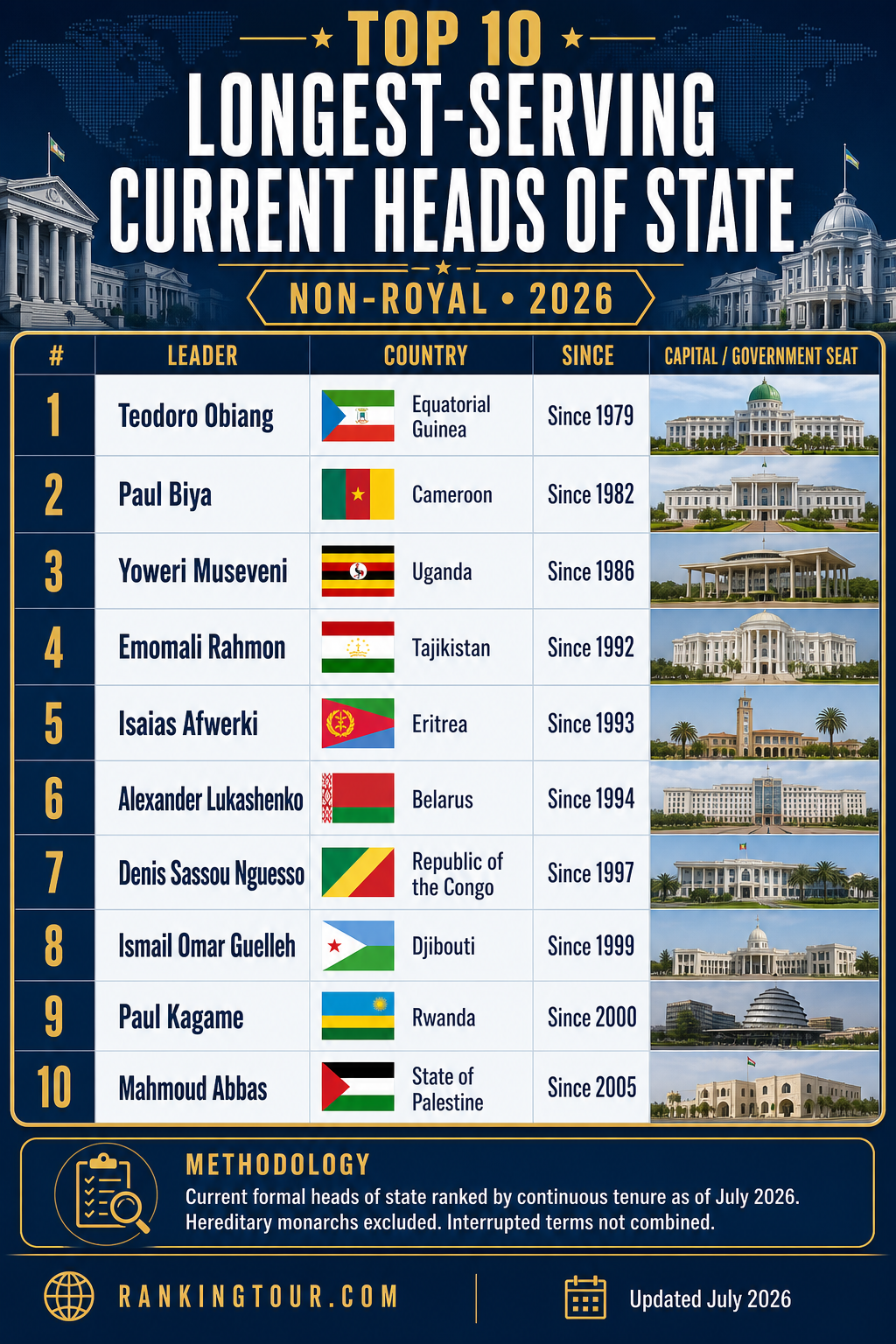
Some national leaders remain in office for decades, outlasting generations of international counterparts. This ranking identifies the longest-serving current heads of state who did not inherit their positions.
To keep the comparison consistent, we rank leaders by their continuous service as the formal head of state. Monarchs and hereditary rulers are excluded, as are prime ministers who are not heads of state. Earlier, interrupted terms are not added to a leader’s current tenure.
Top 10 at a Glance
| Rank | Leader | Country | Head of State Since | Tenure as of July 10, 2026 |
|---|---|---|---|---|
| 1 | Teodoro Obiang Nguema Mbasogo | Equatorial Guinea | August 3, 1979 | About 46 years, 11 months |
| 2 | Paul Biya | Cameroon | November 6, 1982 | About 43 years, 8 months |
| 3 | Yoweri Museveni | Uganda | January 29, 1986 | About 40 years, 5 months |
| 4 | Emomali Rahmon | Tajikistan | November 20, 1992 | About 33 years, 7 months |
| 5 | Isaias Afwerki | Eritrea | May 24, 1993 | About 33 years, 1 month |
| 6 | Alexander Lukashenko | Belarus | July 20, 1994 | About 31 years, 11 months |
| 7 | Denis Sassou Nguesso | Republic of the Congo | October 1997 | About 28 years, 8 months |
| 8 | Ismail Omar Guelleh | Djibouti | May 8, 1999 | About 27 years, 2 months |
| 9 | Paul Kagame | Rwanda | April 22, 2000 | About 26 years, 2 months |
| 10 | Mahmoud Abbas | State of Palestine | January 15, 2005 | About 21 years, 6 months |
10. Mahmoud Abbas – State of Palestine
Mahmoud Abbas became president of the Palestinian Authority in January 2005 and continues to serve as president of the State of Palestine. His inclusion requires an important qualification: Palestine’s international recognition and the Palestinian Authority’s effective territorial control remain politically contested. If the ranking is restricted to United Nations member states only, Nicaragua’s Daniel Ortega, continuously in office since January 2007, takes the tenth position.
9. Paul Kagame – Rwanda
Paul Kagame formally became president of Rwanda on April 22, 2000. He had already been widely regarded as the country’s dominant political and military figure after 1994, but this list counts only his formal tenure as head of state. Kagame won another presidential term in 2024.
8. Ismail Omar Guelleh – Djibouti
Ismail Omar Guelleh succeeded Hassan Gouled Aptidon as president on May 8, 1999. He has since remained the central figure in Djibouti’s political system and won a sixth term in 2026.
7. Denis Sassou Nguesso – Republic of the Congo
Denis Sassou Nguesso returned to power in 1997 and has remained president ever since. He also governed from 1979 to 1992, but that earlier period is excluded because his rule was interrupted. Only his current continuous tenure is used here.
6. Alexander Lukashenko – Belarus
Alexander Lukashenko took office on July 20, 1994, after winning Belarus’s first presidential election. He has been the country’s only president since the office was created. Western governments have disputed the legitimacy of elections held during his long rule, particularly since 2020.
5. Isaias Afwerki – Eritrea
Isaias Afwerki became Eritrea’s first president when the country formally achieved independence on May 24, 1993. He remains the only president Eritrea has had. The country has not held a national presidential election during his tenure.
4. Emomali Rahmon – Tajikistan
Emomali Rahmon became Tajikistan’s head of state in November 1992 as chairman of the Supreme Soviet, then assumed the presidency in November 1994. Because this ranking measures continuous service as head of state rather than time holding the title of president alone, his tenure begins in 1992.
3. Yoweri Museveni – Uganda
Yoweri Museveni became president of Uganda on January 29, 1986, following a five-year guerrilla war. He has since won repeated elections and remained in office after constitutional changes removed presidential term and age limits.
2. Paul Biya – Cameroon
Paul Biya assumed Cameroon’s presidency on November 6, 1982, following the resignation of Ahmadou Ahidjo. Re-elected again in 2025, Biya is both one of the world’s oldest sitting presidents and its second-longest-serving current non-royal head of state.
1. Teodoro Obiang Nguema Mbasogo – Equatorial Guinea
Teodoro Obiang has served as Equatorial Guinea’s head of state since August 3, 1979, when he took power in a military coup. He later became president under the 1982 constitution. With nearly 47 continuous years in power by July 2026, he ranks first among current non-hereditary heads of state.
How This Ranking Was Calculated
- Current officeholders only: the leader must still be serving on July 10, 2026.
- Formal heads of state: prime ministers and de facto leaders are excluded unless they formally held the head-of-state office.
- Non-hereditary positions: kings, queens, sultans, emirs and other hereditary monarchs are excluded.
- Continuous tenure: interrupted periods in office are not combined.
Because constitutional roles, international recognition and accession dates can be interpreted differently, rankings may vary slightly depending on methodology. This list uses formal, continuous head-of-state tenure and clearly notes the main borderline case.
Sources
- Ministry of Foreign Affairs country profiles
- State House Uganda: The President
- Government of Rwanda: The President
- Presidency of the Republic of Congo: Biography
- Office of the President of Palestine
Tenure lengths are rounded to the nearest month and calculated as of July 10, 2026.
About the Author