Top 10 Happiest Countries in the World 2026 — World Happiness Report
Updated: July 2026
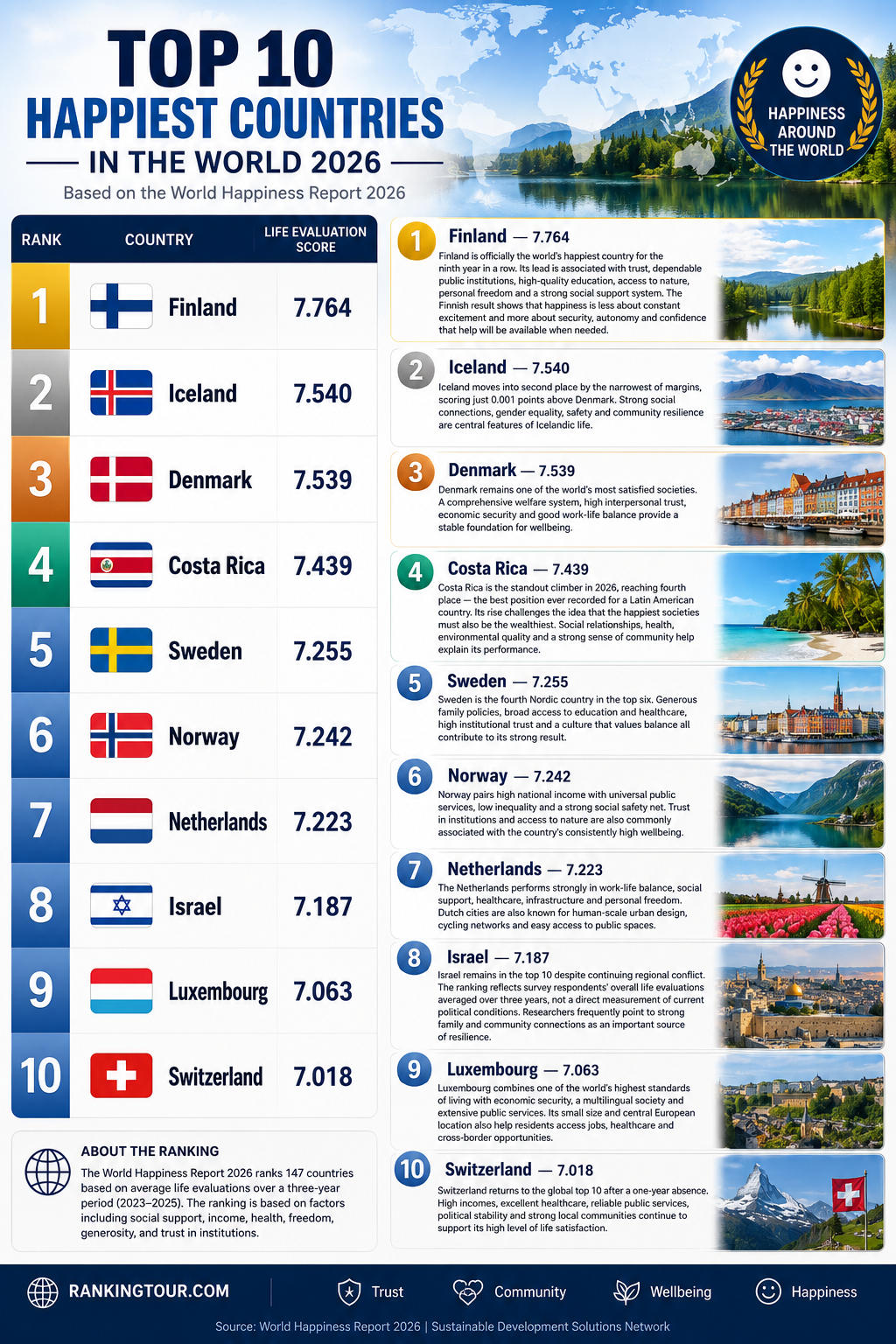
Which countries are the happiest in the world? The World Happiness Report 2026 ranks 147 countries using how residents evaluate their own lives. Finland leads the global happiness ranking for a record ninth consecutive year, while Costa Rica reaches the highest position ever achieved by a Latin American country.
The 2026 results are based mainly on Gallup World Poll responses collected from 2023 through 2025. Participants rate their lives on the Cantril Ladder, a scale from 0 for the worst possible life to 10 for the best possible life.
Top 10 Happiest Countries in the World 2026
| Rank | Country | Life Evaluation Score |
|---|---|---|
| 1 | Finland | 7.764 |
| 2 | Iceland | 7.540 |
| 3 | Denmark | 7.539 |
| 4 | Costa Rica | 7.439 |
| 5 | Sweden | 7.255 |
| 6 | Norway | 7.242 |
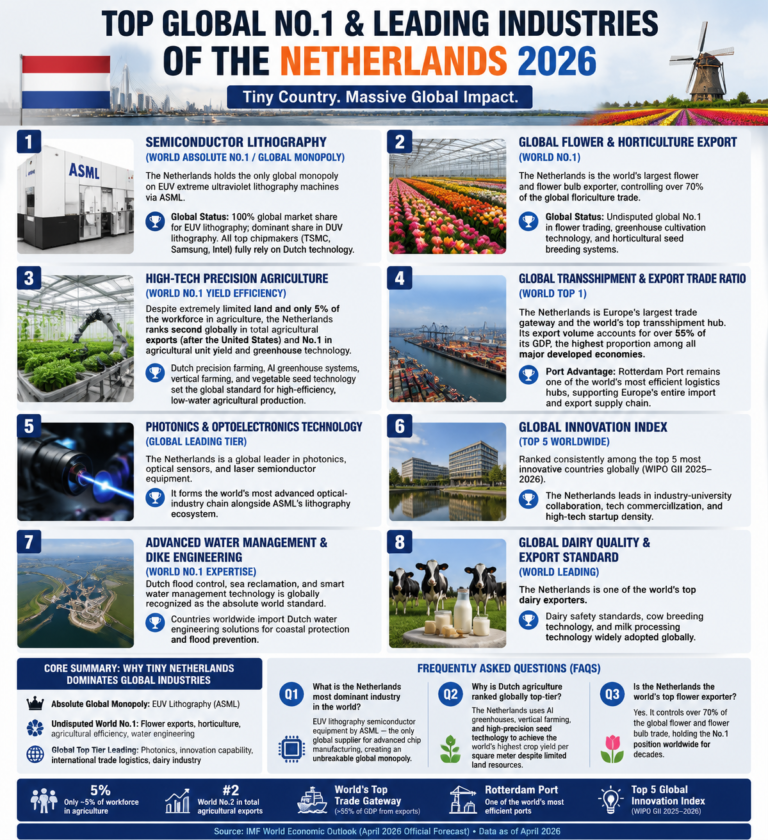
| 7 | Netherlands | 7.223 |
| 8 | Israel | 7.187 |
| 9 | Luxembourg | 7.063 |
| 10 | Switzerland | 7.018 |
10. Switzerland — 7.018
Switzerland returns to the global top 10 after a one-year absence. High incomes, excellent healthcare, reliable public services, political stability and strong local communities continue to support its high level of life satisfaction.
9. Luxembourg — 7.063
Luxembourg combines one of the world’s highest standards of living with economic security, a multilingual society and extensive public services. Its small size and central European location also help residents access jobs, healthcare and cross-border opportunities.
8. Israel — 7.187
Israel remains in the top 10 despite continuing regional conflict. The ranking reflects survey respondents’ overall life evaluations averaged over three years, not a direct measurement of current political conditions. Researchers frequently point to strong family and community connections as an important source of resilience.
7. Netherlands — 7.223
The Netherlands performs strongly in work-life balance, social support, healthcare, infrastructure and personal freedom. Dutch cities are also known for human-scale urban design, cycling networks and easy access to public spaces.
6. Norway — 7.242
Norway pairs high national income with universal public services, low inequality and a strong social safety net. Trust in institutions and access to nature are also commonly associated with the country’s consistently high wellbeing.
5. Sweden — 7.255
Sweden is the fourth Nordic country in the top six. Generous family policies, broad access to education and healthcare, high institutional trust and a culture that values balance all contribute to its strong result.
4. Costa Rica — 7.439
Costa Rica is the standout climber in 2026, reaching fourth place — the best position ever recorded for a Latin American country. Its rise challenges the idea that the happiest societies must also be the wealthiest. Social relationships, health, environmental quality and a strong sense of community help explain its performance.
3. Denmark — 7.539
Denmark remains one of the world’s most satisfied societies. A comprehensive welfare system, high interpersonal trust, economic security and good work-life balance provide a stable foundation for wellbeing.
2. Iceland — 7.540
Iceland moves into second place by the narrowest of margins, scoring just 0.001 points above Denmark. Strong social connections, gender equality, safety and community resilience are central features of Icelandic life.
1. Finland — 7.764
Finland is officially the world’s happiest country for the ninth year in a row. Its lead is associated with trust, dependable public institutions, high-quality education, access to nature, personal freedom and a strong social support system. The Finnish result shows that happiness is less about constant excitement and more about security, autonomy and confidence that help will be available when needed.
How the World Happiness Ranking Works
The ranking is based on a single core question: people are asked to imagine a ladder with steps numbered from 0 to 10 and indicate where they feel they currently stand. National results are calculated from representative survey responses and averaged across three years.
Six frequently discussed factors — GDP per capita, social support, healthy life expectancy, freedom to make life choices, generosity and perceptions of corruption — help researchers explain differences between countries. However, these factors do not directly determine the ranking; the positions come from residents’ own life evaluations.
Key Findings from 2026
- Finland ranks first for the ninth consecutive year.
- Iceland moves ahead of Denmark by only 0.001 points.
- Costa Rica reaches fourth, the highest-ever result for Latin America.
- Five of the top seven countries are Nordic.
- No English-speaking country appears in the top 10 for the second consecutive year.
- New Zealand ranks 11th, while the United States falls to 23rd and Canada to 25th.
- Afghanistan ranks last, with a life-evaluation score of 1.446.
What Makes a Country Happy?
The 2026 ranking reinforces a consistent lesson: national happiness depends on more than wealth. Prosperity matters, but social trust, supportive relationships, effective institutions, health, freedom and a sense of belonging often distinguish the highest-ranking societies.
The report also focuses on social media and wellbeing. It finds a complex relationship rather than a simple rule: heavy use is linked with lower wellbeing for many young people, especially in parts of the English-speaking world and Western Europe, while social connection and belonging show even stronger associations with life satisfaction.
Sources
- World Happiness Report 2026
- World Happiness Report 2026 Statistical Appendix
- Official 2026 report announcement
Scores and ranks are based on the World Happiness Report 2026 and reflect average life evaluations for 2023–2025.
About the Author