Carlo Ancelotti Leads the Ranking With €10 Million Annual Salary
The 2026 FIFA World Cup featured some of the world’s most famous football managers, with several national teams investing millions of euros in elite coaching talent.
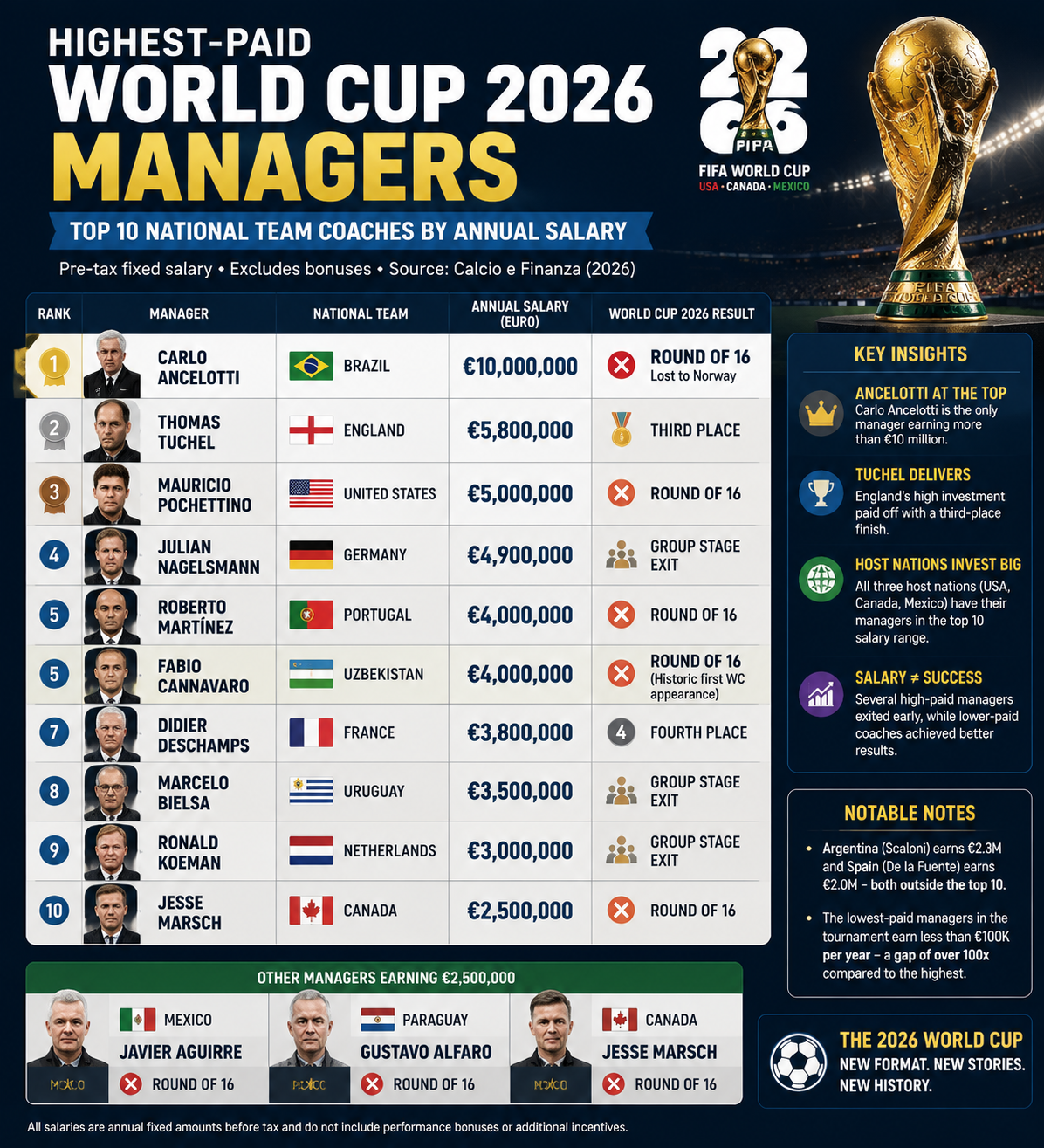
According to pre-tournament salary data compiled by Calcio e Finanza (2026), the following ranking compares the top 10 highest-paid FIFA World Cup 2026 managers based on their annual fixed salary before tax.
Note: Salaries exclude performance bonuses, sponsorship income, and additional incentives. All figures are converted into euros.
Top 10 Highest-Paid FIFA World Cup 2026 Managers
| Rank | Manager | National Team | Annual Salary | World Cup 2026 Result |
|---|---|---|---|---|
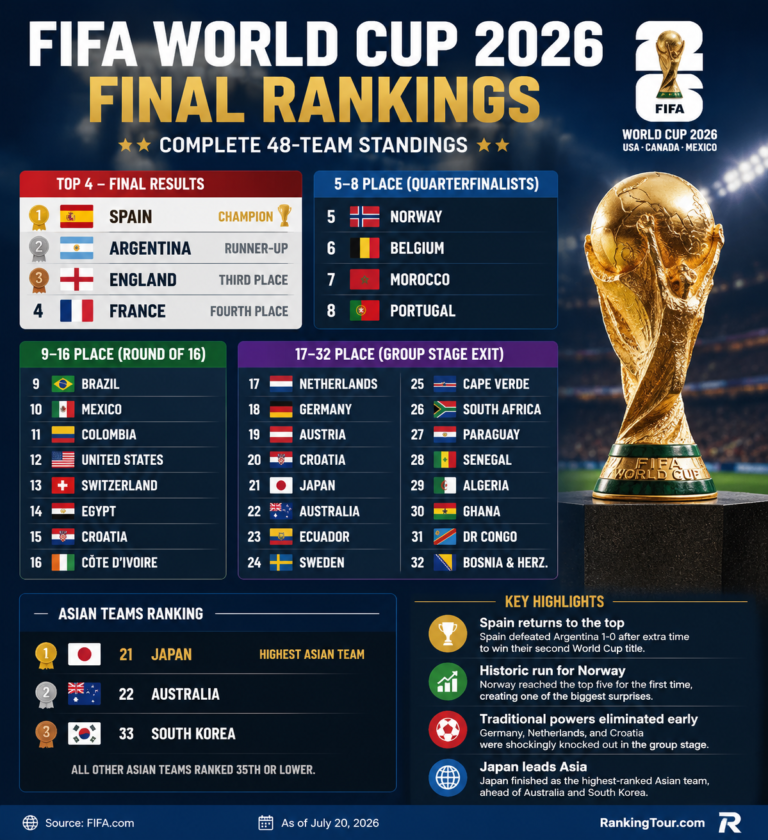
| 🥇 1 | Carlo Ancelotti | Brazil 🇧🇷 | €10 million | Round of 16 (Lost to Norway) |
| 🥈 2 | Thomas Tuchel | England 🏴 | €5.8 million | Third Place |
| 🥉 3 | Mauricio Pochettino | United States 🇺🇸 | €5 million | Round of 16 |
| 4 | Julian Nagelsmann | Germany 🇩🇪 | €4.9 million | Group Stage Exit |
| 5 | Roberto Martínez | Portugal 🇵🇹 | €4 million | Round of 16 |
| 5 | Fabio Cannavaro | Uzbekistan 🇺🇿 | €4 million | Round of 16 |
| 7 | Didier Deschamps | France 🇫🇷 | €3.8 million | Fourth Place |
| 8 | Marcelo Bielsa | Uruguay 🇺🇾 | €3.5 million | Group Stage Exit |
| 9 | Ronald Koeman | Netherlands 🇳🇱 | €3 million | Group Stage Exit |
| 10 | Jesse Marsch | Canada 🇨🇦 | €2.5 million | Round of 16 |
Other Managers Receiving €2.5 Million
Three additional managers were reported with annual salaries of approximately €2.5 million:
| Manager | Team | World Cup 2026 Result |
|---|---|---|
| Jesse Marsch | Canada 🇨🇦 | Round of 16 |
| Javier Aguirre | Mexico 🇲🇽 | Round of 16 |
| Guillermo Barros Schelotto / Gustavo Alfaro | Paraguay 🇵🇾 | Round of 16 |
Key Insights From the Salary Ranking
1. Carlo Ancelotti Was the Only Manager Above €10 Million
Brazil’s Carlo Ancelotti became the highest-paid national team manager at the 2026 World Cup.
His €10 million annual salary was significantly higher than any other coach in the tournament.
Ancelotti also became Brazil’s first foreign-born head coach, with his contract reportedly extending through 2030.
2. England’s Tuchel Delivered the Best Result Among the Highest-Paid Coaches
Thomas Tuchel ranked second in salary (€5.8 million) and guided England to a third-place finish, becoming the highest-ranked coach among the top salary group.
3. Host Nations Invested Heavily in Coaching
All three 2026 World Cup host nations placed their managers among the highest-paid coaches:
🇺🇸 United States — Mauricio Pochettino (€5 million)
🇨🇦 Canada — Jesse Marsch (€2.5 million)
🇲🇽 Mexico — Javier Aguirre (€2.5 million)
This reflects the significant investment made by North American football organizations ahead of the expanded tournament.
4. Salary Does Not Always Guarantee Success
Several highly paid managers experienced disappointing results:
- 🇧🇷 Carlo Ancelotti — Round of 16 exit
- 🇩🇪 Julian Nagelsmann — Group Stage exit
- 🇳🇱 Ronald Koeman — Group Stage exit
- 🇺🇾 Marcelo Bielsa — Group Stage exit
Meanwhile, some lower-paid managers achieved stronger tournament performances.
Champions’ Coach Ranked Outside the Top 10
Despite winning the 2026 FIFA World Cup, Spain manager Luis de la Fuente earned approximately €2 million per year, ranking below many of Europe’s highest-paid coaches.
Defending champion Argentina’s manager Lionel Scaloni reportedly earned around €2.3 million, also missing the top 10.
This highlights the significant gap between coaching reputation, national team budgets, and tournament results.
The Biggest Salary Gap in World Cup Management
The difference between the highest-paid and lowest-paid national team coaches was enormous.
While elite managers earned several million euros annually, coaches from smaller football nations reportedly earned less than €100,000 per year.
The gap between the highest and lowest salaries reached more than 100 times.
Conclusion
The 2026 FIFA World Cup showed that national teams continue to invest heavily in world-class managers.
However, the tournament also demonstrated that salary alone does not determine success.
Spain’s championship victory, Norway’s breakthrough performance, and several unexpected early exits proved that tactical quality, team balance, and tournament execution remain decisive factors in international football.
About the Author