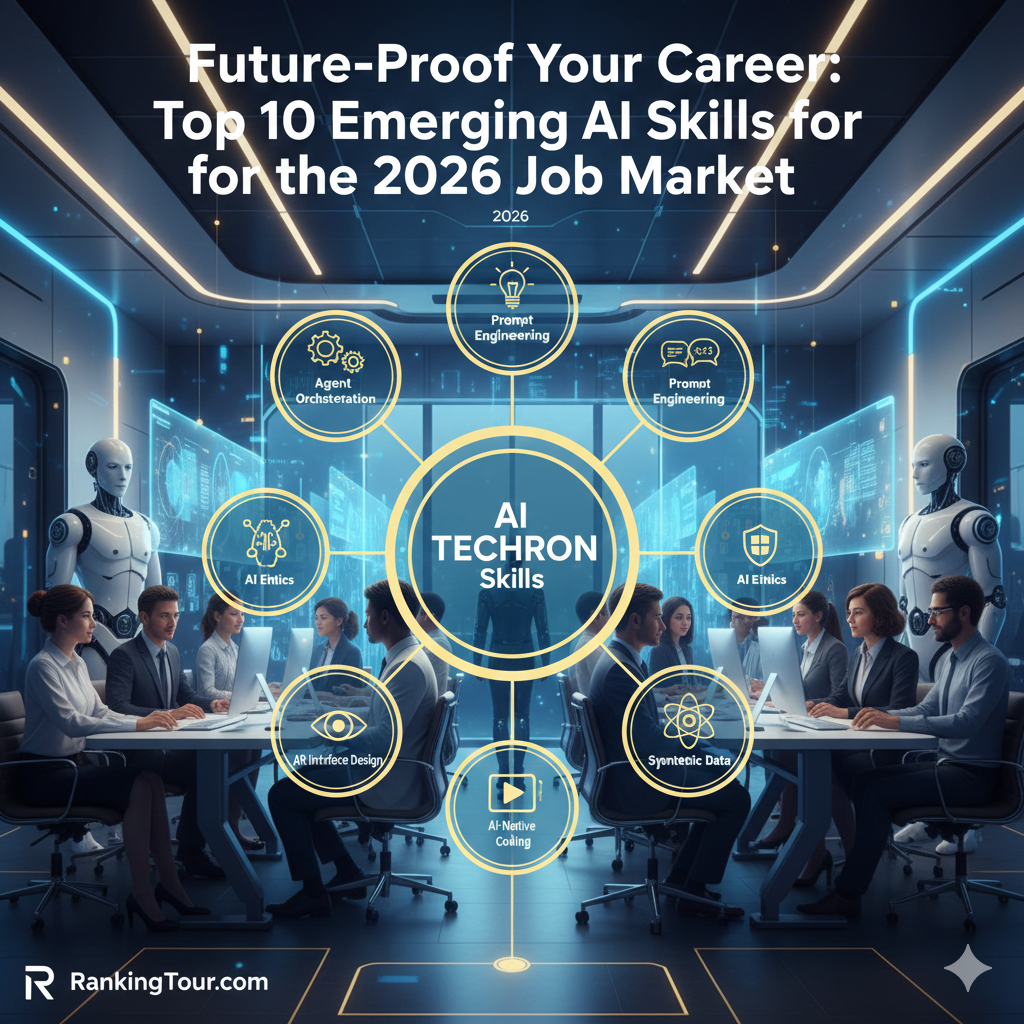
By 2026, the question is no longer “Will AI replace my job?” but “How can I use AI to do my job better?” As AI agents and humanoid robots become integrated into every industry, a new set of skills has emerged as the “gold standard” for employability.
If you want to remain indispensable in the 2026 labor market, these are the Top 10 AI skills you need to master.
1. AI Agent Orchestration
What it is: Moving beyond single prompts to managing a “fleet” of AI agents. In 2026, companies don’t just use one AI; they use dozens of specialized agents for coding, marketing, and logistics. Skills in orchestrating these agents to work together in a seamless workflow are the most high-demand capability today.
2. Advanced Prompt Engineering & Latent Space Navigation
What it is: Precision communication with Large Language Models (LLMs). Basic prompting is now a common skill. Advanced professionals in 2026 understand “Latent Space”—how to guide AI through complex reasoning paths to get highly specific, error-free outputs for technical and creative tasks.
3. Human-Robot Collaboration (HRC)
What it is: Working physically alongside humanoid robots like Tesla Optimus or Figure 02. With humanoids entering factories and hospitals, the ability to calibrate, troubleshoot, and supervise robotic “co-workers” is a top skill in manufacturing and healthcare.
4. AI Ethics & Compliance Auditing
What it is: Ensuring AI systems are unbiased, transparent, and legal. As governments worldwide have passed strict AI regulations by 2026, companies are hiring “Ethics Officers” to ensure their algorithms don’t violate privacy laws or display social bias.
5. Synthetic Data Management
What it is: Creating and curating high-quality data generated by AI to train other AI. Since high-quality human data has become scarce, the ability to generate “Synthetic Data” that mimics real-world scenarios without compromising privacy is a crucial skill for data scientists.
6. Real-time AI Video & Media Production
What it is: Using generative AI tools (like Sora or Veo) for instant content creation. The marketing landscape of 2026 relies on “instant ads”—videos created in minutes for specific target audiences. Proficiency in AI-driven cinematography and editing is now a core requirement for creators.
7. Augmented Reality (AR) Interface Design
What it is: Designing AI-driven overlays for smart glasses and headsets. With the widespread adoption of AR glasses, the ability to design AI interfaces that provide real-time information to users in their field of vision is a booming field for UX designers.
8. Predictive Analytics & AI Forecasting
What it is: Using AI to “see the future” of market trends and supply chains. Business analysts in 2026 use AI to predict shifts in consumer behavior months in advance. Mastering AI forecasting tools is essential for any leadership or strategic role.
9. Personal AI Branding & Customization
What it is: Training “Mini-GPTs” or personal AI twins for specific business needs. Professionals are now expected to have their own customized AI “sidekicks.” Knowing how to fine-tune an AI model on your specific professional knowledge is a major productivity booster.
10. AI-Native Coding & Debugging
What it is: Coding with AI as the primary writer, while the human acts as the architect. In 2026, humans rarely write boilerplate code. The skill has shifted to high-level architecture—knowing how to instruct AI to build complex systems and, more importantly, how to debug the “black box” of AI-generated code.
Conclusion: The Rise of the “Centaur” Professional
In 2026, the most successful workers are “Centaurs”—part human intuition, part AI speed. Technology is moving faster than ever, but these 10 skills ensure that you aren’t just watching the future happen—you are leading it.
About The Author