The World’s Leading Aviation Engine Companies Ranked
Aircraft engines are among the most advanced machines ever created.
A modern turbofan engine requires:
- Advanced materials
- Artificial intelligence systems
- Precision manufacturing
- Extreme temperature technology
- Decades of engineering experience
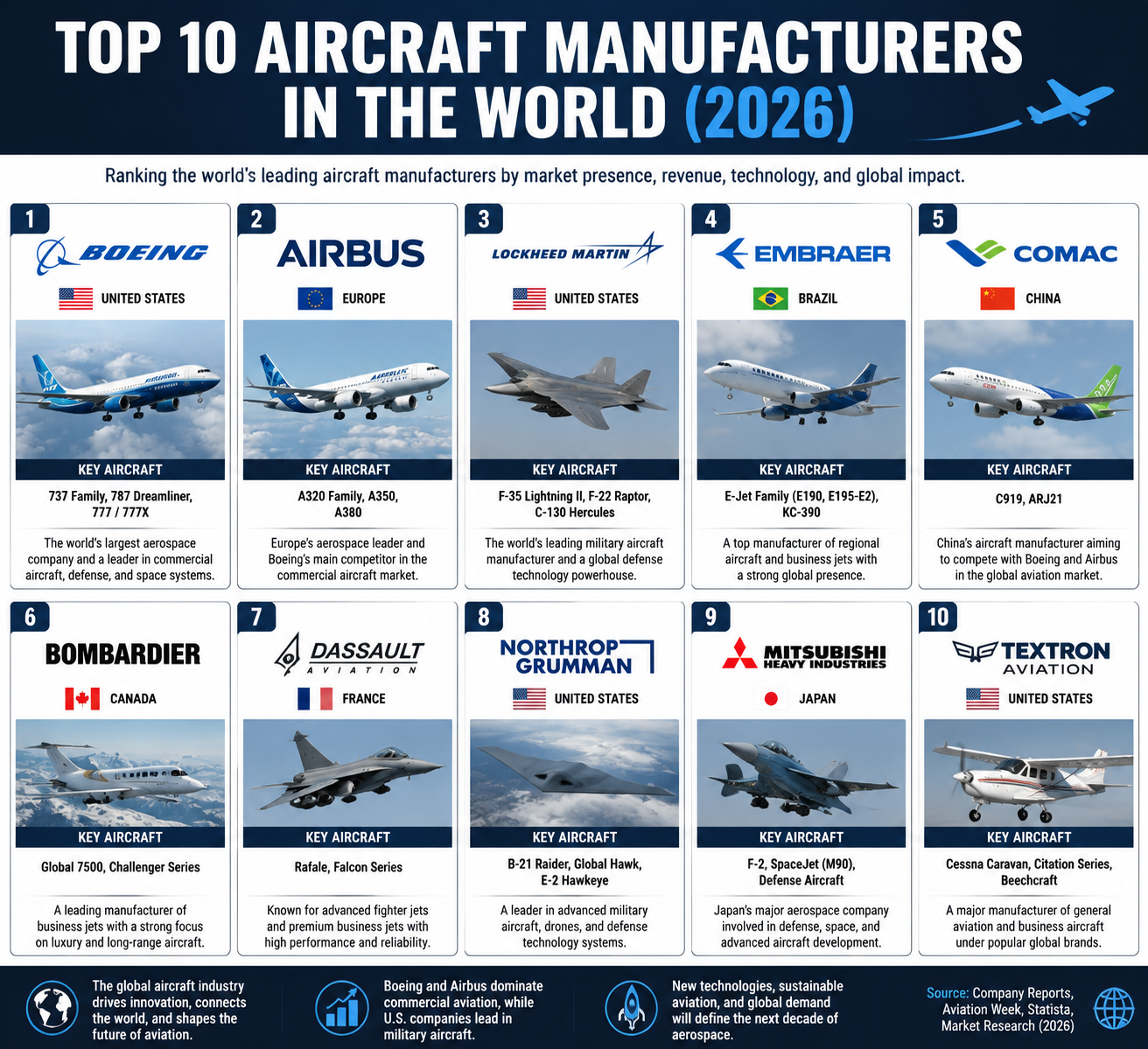
Unlike aircraft manufacturing, where Boeing and Airbus dominate commercial aviation, the aircraft engine industry is controlled by a small number of highly specialized companies. The global market is mainly dominated by GE Aerospace, CFM International, Pratt & Whitney, and Rolls-Royce.
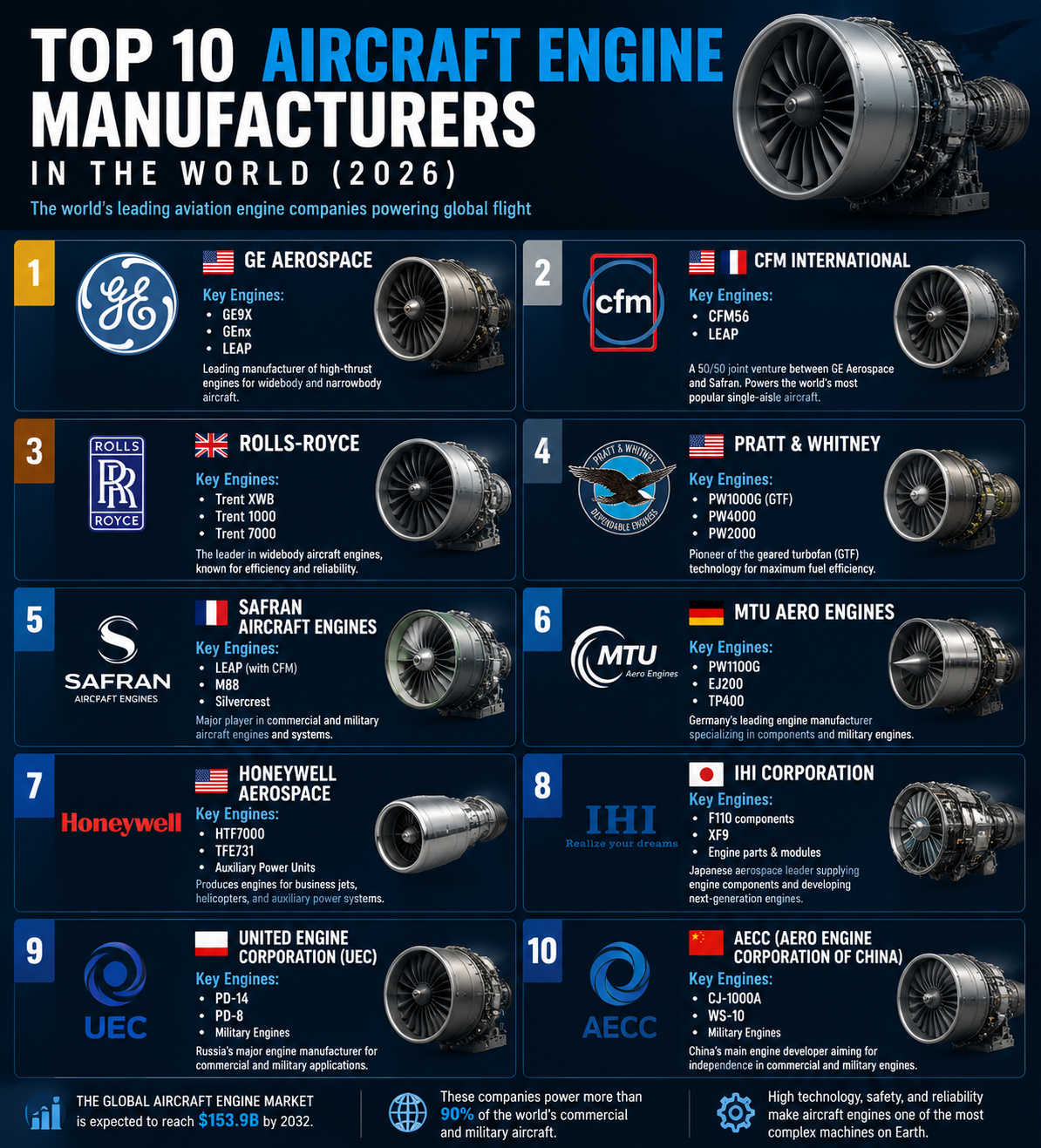
Top 10 Aircraft Engine Manufacturers in the World (2026)
| Rank | Company | Country | Main Products |
|---|---|---|---|
| 🥇 1 | GE Aerospace | 🇺🇸 USA | GE9X, GEnx, LEAP |
| 🥈 2 | CFM International | 🇺🇸🇫🇷 USA / France | CFM56, LEAP |
| 🥉 3 | Rolls-Royce | 🇬🇧 UK | Trent XWB, Trent 1000 |
| 4 | Pratt & Whitney | 🇺🇸 USA | GTF, PW4000 |
| 5 | Safran Aircraft Engines | 🇫🇷 France | LEAP, M88 |
| 6 | MTU Aero Engines | 🇩🇪 Germany | PW1100G, EJ200 |
| 7 | Honeywell Aerospace | 🇺🇸 USA | HTF, TFE engines |
| 8 | IHI Corporation | 🇯🇵 Japan | F110 components, XF9 |
| 9 | United Engine Corporation (UEC) | 🇷🇺 Russia | PD-14, military engines |
| 10 | AECC (Aero Engine Corporation of China) | 🇨🇳 China | CJ-1000A, military engines |
1. GE Aerospace 🇺🇸
World’s Most Powerful Aircraft Engine Company
GE Aerospace is one of the world’s largest aircraft engine manufacturers.
Main engines:
GE9X
Used on:
- Boeing 777X
The GE9X is currently one of the world’s largest and most powerful commercial aircraft engines.
GEnx
Used on:
- Boeing 787 Dreamliner
- Boeing 747-8
LEAP Engine
Produced through CFM International.
GE also earns significant revenue from aircraft engine maintenance and services, with a large global installed engine base.
2. CFM International 🇺🇸🇫🇷
The World’s Most Successful Narrowbody Engine Manufacturer
CFM International is a 50/50 joint venture between:
- GE Aerospace
- Safran Aircraft Engines
Main engines:
CFM56
One of the most successful jet engines ever produced.
Used on:
- Airbus A320 family
- Boeing 737 Classic
LEAP
Used on:
- Boeing 737 MAX
- Airbus A320neo
CFM engines power a large percentage of the world’s commercial narrowbody aircraft fleet.
3. Rolls-Royce 🇬🇧
The Leader in Widebody Aircraft Engines
Rolls-Royce is one of the world’s most famous aviation engine manufacturers.
Main engines:
Trent XWB
Used on:
- Airbus A350
Trent 1000
Used on:
- Boeing 787
Strength:
✅ Long-range aircraft
✅ Large passenger jets
✅ High-thrust engines
Rolls-Royce is especially dominant in the widebody aircraft market.
4. Pratt & Whitney 🇺🇸
Pioneer of Geared Turbofan Technology
Pratt & Whitney has a century-long aviation history.
Main engines:
PW1000G GTF
Used on:
- Airbus A220
- Airbus A320neo
- Embraer E2
Advantages:
- Lower fuel consumption
- Reduced noise
- Improved efficiency
5. Safran Aircraft Engines 🇫🇷
Safran is one of Europe’s largest aerospace companies.
Major programs:
- CFM International
- LEAP engine
- Military engine development
Safran is a key partner in the global commercial aviation engine market.
6. MTU Aero Engines 🇩🇪
Germany’s largest aircraft engine manufacturer.
Main areas:
- Commercial engine components
- Military engines
- Maintenance services
Major programs:
- PW1100G
- Eurojet EJ200
7. Honeywell Aerospace 🇺🇸
Honeywell specializes in:
- Business aircraft engines
- Auxiliary power units (APU)
- Aerospace systems
Its products are widely used in:
- Business jets
- Helicopters
- Military aircraft
8. IHI Corporation 🇯🇵
Japan’s leading aerospace engine company.
Main activities:
- Engine components
- Military propulsion
- Joint international programs
IHI participates in major global aircraft engine supply chains.
9. United Engine Corporation (UEC) 🇷🇺
Russia’s major aircraft engine manufacturer.
Main engines:
- PD-14
- Military turbofan engines
UEC supports:
- Russian commercial aircraft
- Fighter aircraft
10. AECC (Aero Engine Corporation of China) 🇨🇳
China established AECC to develop domestic aircraft engine technology.
Major projects:
- CJ-1000A
- Military aircraft engines
China’s goal is reducing dependence on foreign engines for commercial aircraft such as the COMAC C919.
Global Aircraft Engine Market Structure
Commercial Aviation Engine Leaders
| Segment | Leading Companies |
|---|---|
| Narrowbody Aircraft | CFM, Pratt & Whitney |
| Widebody Aircraft | GE Aerospace, Rolls-Royce |
| Business Jets | Honeywell, GE |
| Military Engines | GE, Pratt & Whitney, Safran, UEC |
Why Aircraft Engines Are So Difficult to Manufacture?
A modern jet engine operates under extreme conditions:
🔥 Temperature above 1,000°C
💨 Air speeds above Mach 1
⚙️ Tens of thousands of rotating parts
🛠 Decades of certification requirements
Developing a new aircraft engine can require:
- 8–10 years of development
- Billions of dollars investment
- Strict aviation certification
Key Insights
1. Four Companies Control Most of the Market
The commercial aircraft engine industry is essentially dominated by:
- GE Aerospace
- CFM International
- Pratt & Whitney
- Rolls-Royce
2. Maintenance Is a Huge Business
Aircraft engines generate revenue long after initial sales through:
- Repair
- Maintenance
- Spare parts
- Engine leasing
This creates long-term recurring revenue for manufacturers.
3. China Is Trying to Challenge Western Dominance
China’s AECC is investing heavily in domestic engine technology, but global certification and reliability remain major challenges.
Conclusion
The world’s aircraft engine industry is one of the most technologically advanced sectors on Earth.
While Boeing and Airbus dominate aircraft production, the engine market belongs to a small group of engineering giants:
🏆 GE Aerospace
🏆 CFM International
🏆 Rolls-Royce
🏆 Pratt & Whitney
These companies power the global aviation industry and will play a critical role in the future of:
- Sustainable aviation
- Hybrid aircraft
- Next-generation engines
- Space transportation
About the Author