Top 10 commercial spacecraft companies like SpaceX in 2026.
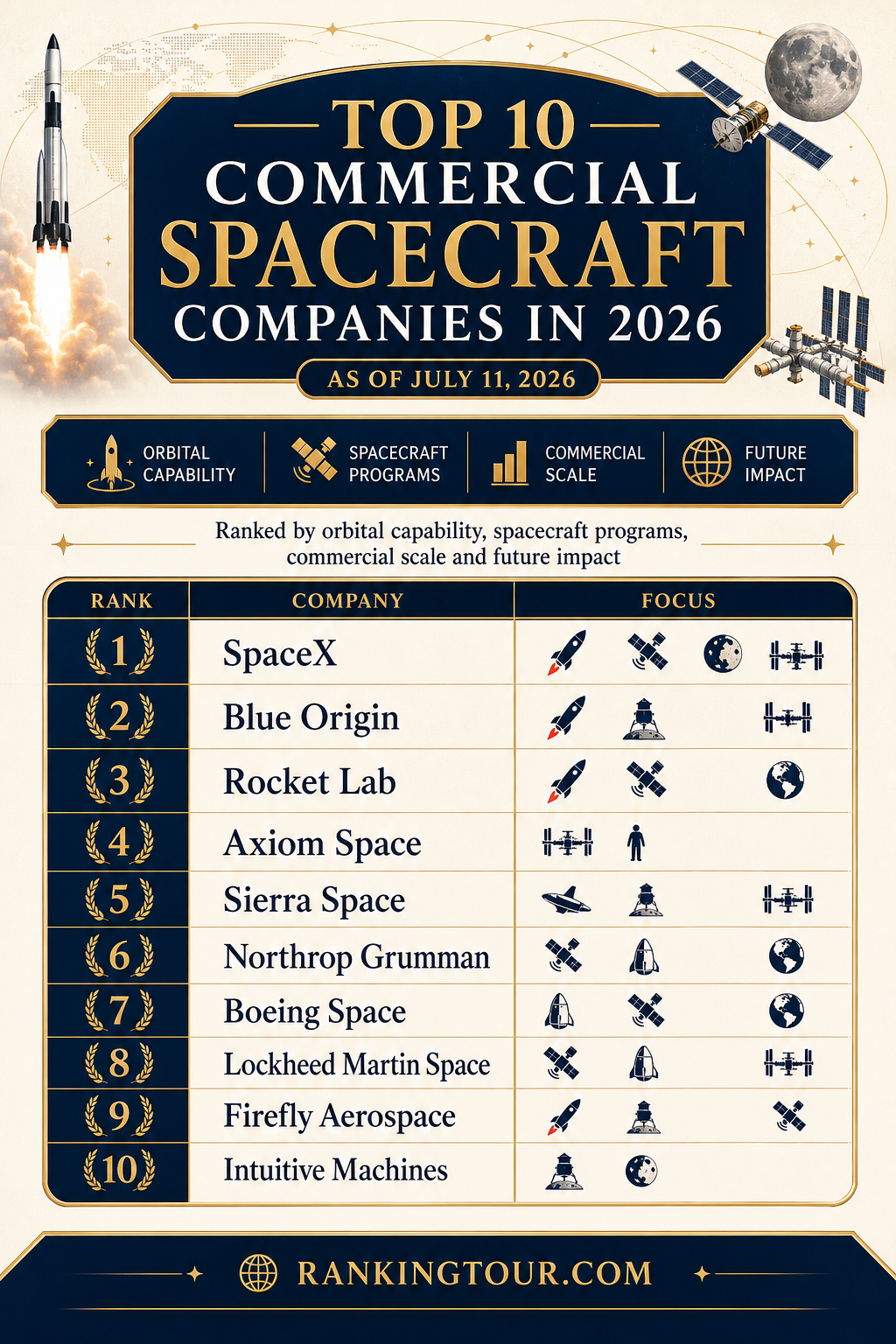
Updated July 11, 2026. This ranking looks at commercial space companies that are closest to the SpaceX model: firms building launch vehicles, crew or cargo spacecraft, commercial stations, lunar landers, reusable systems, satellite platforms, or end-to-end orbital infrastructure.
To keep the list fair, this is not a simple revenue ranking. The order weighs five factors: proven orbital capability, spacecraft programs, commercial scale, government and private customer traction, and future impact. That means a company with a smaller balance sheet but a flight-proven lunar lander can rank above a much larger defense contractor if its spacecraft role is more direct.
Top 10 Commercial Spacecraft Companies Like SpaceX in 2026
| Rank | Company | Main spacecraft focus | Why it ranks here |
|---|---|---|---|
| 1 | SpaceX | Reusable launch, Dragon, Starship, Starlink infrastructure | The benchmark for commercial orbital launch and human spaceflight operations. |
| 2 | Blue Origin | New Glenn, New Shepard, Blue Moon, Blue Ring | A deep-pocketed challenger with heavy-lift, lunar and in-space logistics ambitions. |
| 3 | Rocket Lab | Electron, Neutron, spacecraft buses and satellite components | One of the strongest end-to-end space companies below SpaceX in launch cadence and spacecraft manufacturing. |
| 4 | Axiom Space | Commercial space station, private astronaut missions, spacesuits | A leading company in the transition from ISS-era research to privately operated orbital destinations. |
| 5 | Sierra Space | Dream Chaser spaceplane, LIFE habitat, orbital infrastructure | Its reusable spaceplane and station hardware make it one of the most important non-SpaceX human-spaceflight players. |
| 6 | Northrop Grumman Space Systems | Cygnus cargo spacecraft, station logistics, deep-space modules | Cygnus gives Northrop a proven role in commercial cargo delivery to low Earth orbit. |
| 7 | Boeing Space | CST-100 Starliner, ISS systems, SLS and satellites | Starliner remains one of the few U.S. orbital crew capsule programs, despite a more uneven recent track record. |
| 8 | Lockheed Martin Space | Orion, lunar infrastructure, satellites and exploration systems | A legacy giant whose spacecraft engineering still anchors major exploration programs. |
| 9 | Firefly Aerospace | Alpha launch, Blue Ghost lunar landers, Elytra orbital vehicles | Firefly has moved from small launch into lunar delivery and cislunar services. |
| 10 | Intuitive Machines | Nova-C lunar landers and lunar data/services | A focused lunar company that helped prove the commercial Moon-delivery market is real. |
1. SpaceX
SpaceX is still the company everyone else in commercial space is measured against. Falcon 9, Falcon Heavy, Dragon, Starlink and Starship give it unmatched breadth across launch, spacecraft, satellite networks and future deep-space transport. NASA’s Commercial Crew Program page continues to list current SpaceX crew missions, and describes the program as a partnership with private industry for safe, reliable and cost-effective human transport to the International Space Station.
Why it ranks No. 1: SpaceX combines high launch cadence, operational crew transport, cargo return capability, satellite scale and the industry’s most ambitious fully reusable spacecraft program.
2. Blue Origin
Blue Origin ranks second because it is not merely a launch startup anymore. Its New Glenn rocket is designed as a reusable heavy-lift vehicle, and the company is also working on lunar systems and in-space platforms. Blue Origin says New Glenn is built for larger payloads, with a reusable first stage and up to 45 metric tons to low Earth orbit.
Why it ranks No. 2: New Glenn, Blue Moon and Blue Ring give Blue Origin one of the broadest future spacecraft portfolios in the commercial market.
3. Rocket Lab
Rocket Lab has become much more than a small-launch company. Its own materials describe it as an “end-to-end space company” delivering launch, spacecraft design and manufacturing, satellite components and flight software. Electron remains a reliable small launcher, while Neutron targets a much larger class of missions.
Why it ranks No. 3: Rocket Lab blends real launch heritage with spacecraft manufacturing and satellite technology, giving it unusually complete vertical integration.
4. Axiom Space
Axiom Space is central to the post-ISS commercial station race. Its Axiom Station project is positioned as the world’s first commercial space station, with module development progressing in partnership with NASA and industrial partners. Axiom also runs private astronaut missions and is developing next-generation spacesuit technology.
Why it ranks No. 4: If commercial stations become a major market, Axiom is one of the companies best placed to define it.
5. Sierra Space
Sierra Space earns its spot through Dream Chaser, a reusable lifting-body spaceplane designed for cargo missions and runway landings, plus orbital habitat work. NASA’s commercial resupply program highlights the broader move toward private cargo systems serving the International Space Station and future destinations.
Why it ranks No. 5: Dream Chaser gives Sierra Space a distinctive spacecraft profile: reusable, runway-return, and built for commercial orbital logistics.
6. Northrop Grumman Space Systems
Northrop Grumman is a legacy aerospace company, but its Cygnus spacecraft makes it a serious commercial spaceflight operator. Northrop says Cygnus has delivered more than 159,000 pounds of equipment, experiments and supplies to the ISS under NASA commercial resupply contracts.
Why it ranks No. 6: Cygnus is a proven orbital cargo spacecraft with years of operational logistics experience.
7. Boeing Space
Boeing’s ranking is complicated. Starliner is one of the few U.S. crew capsule systems designed for low Earth orbit transport, but the program has faced high-profile technical setbacks. Boeing describes Starliner as a next-generation spacecraft for transporting humans and cargo to and from low Earth orbit, with reusable crew modules and NASA as anchor customer.
Why it ranks No. 7: Starliner still matters because crewed orbital access is an elite capability, even when execution has been difficult.
8. Lockheed Martin Space
Lockheed Martin Space is not a SpaceX-style pure commercial disruptor, but it remains one of the world’s most important spacecraft builders. Its role in Orion and exploration systems keeps it deeply connected to lunar and deep-space architecture.
Why it ranks No. 8: The company’s spacecraft engineering depth is enormous, though its business model is more traditional government-prime than consumer-facing commercial space.
9. Firefly Aerospace
Firefly has become a serious cislunar player. Its Blue Ghost program is designed for lunar delivery and operations, and Firefly says the lander supports payload delivery, surface operations, lunar orbit services and customized cislunar missions. The company also operates Alpha launch and is expanding its spacecraft line.
Why it ranks No. 9: Firefly’s combination of launch, lunar landers and orbital vehicles makes it one of the most interesting rising commercial space companies.
10. Intuitive Machines
Intuitive Machines is more specialized than many companies on this list, but its lunar focus is strategically important. NASA’s Commercial Lunar Payload Services initiative is built around American companies delivering science and technology to the Moon, and Intuitive Machines has been one of the most visible names in that new market.
Why it ranks No. 10: It represents the new class of commercial lunar-service companies: narrower than SpaceX, but highly relevant to the Moon economy.
2026 Industry Milestone: China Recovers the Long March-10B First Stage
On July 10, 2026, China’s Long March-10B completed its maiden flight from the Hainan Commercial Space Launch Site and achieved the country’s first controlled recovery of a carrier rocket first stage. About six minutes after stage separation, the booster returned vertically and was captured on an offshore recovery platform using a sea-based net system.
The milestone matters to the commercial launch market because the reusable configuration is designed to carry up to 16 metric tons to low Earth orbit while reducing launch costs. The vehicle was developed within the state-owned China Aerospace Science and Technology Corporation system, so it is not ranked here as a private commercial company. Even so, its successful recovery shows that reusable orbital launch is becoming a broader global competitive field rather than a capability associated mainly with SpaceX and Blue Origin.
What This Ranking Shows
The commercial spacecraft market is no longer just a rocket race. SpaceX leads because it has already combined launch, crew transport, cargo, satellite infrastructure and deep-space ambition. But the next decade may be shaped by a wider ecosystem: Blue Origin’s heavy-lift and lunar systems, Rocket Lab’s vertical integration, Axiom’s commercial station, Sierra Space’s reusable spaceplane, and lunar companies such as Firefly and Intuitive Machines.
Sources and Notes
This ranking was compiled from company materials and public space agency references, including NASA’s Commercial Space overview, NASA’s Commercial Crew Program, NASA’s Commercial Resupply Missions, Blue Origin New Glenn, Rocket Lab, Axiom Station, Northrop Grumman Cygnus, Boeing Starliner, Lockheed Martin Orion, Firefly Blue Ghost, and the China Aerospace Science and Technology Corporation’s official Long March-10B maiden-flight report.
About the Author