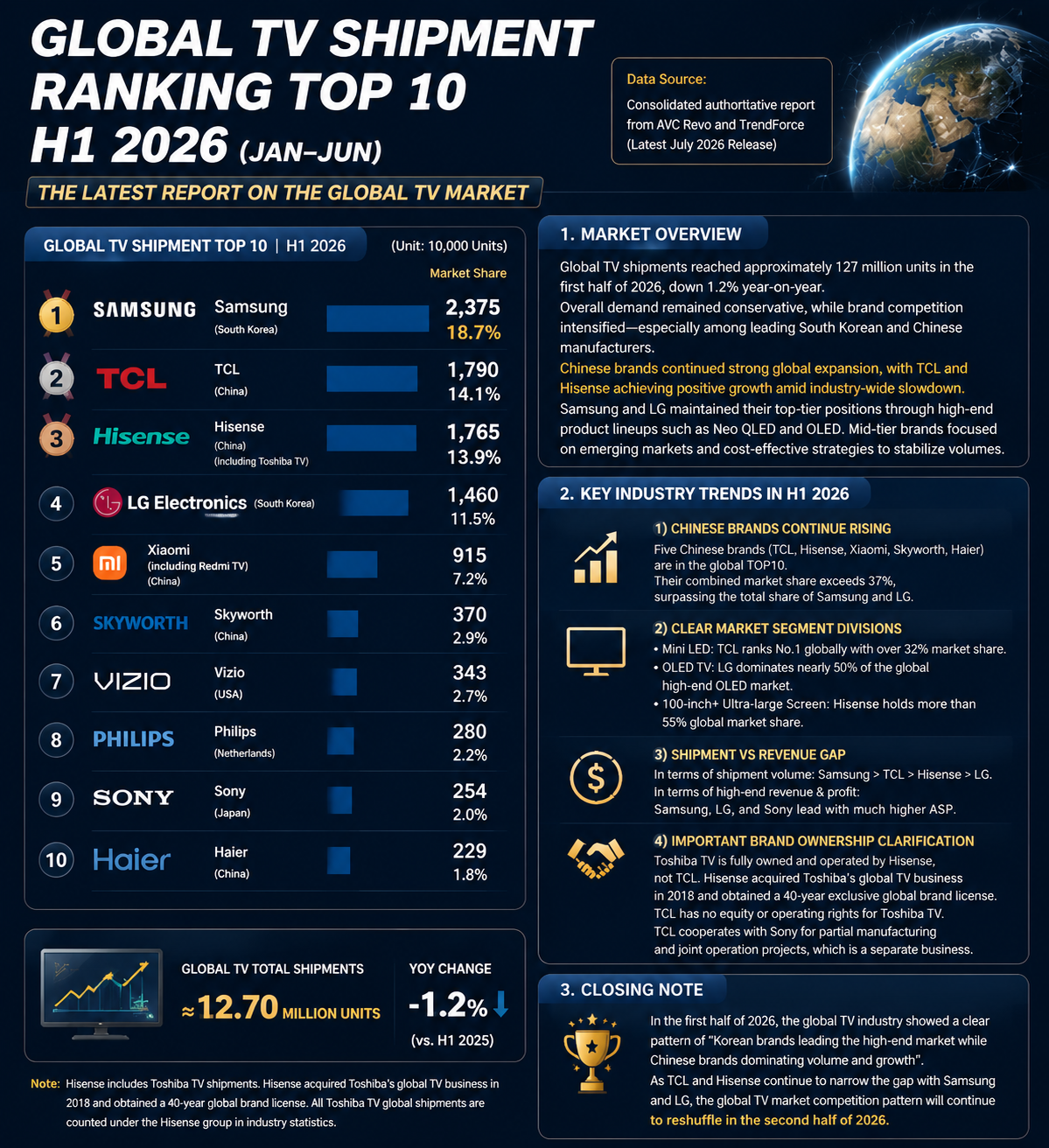
Data Source: Consolidated authoritative report from AVC Revo and TrendForce (Latest July 2026 Release)
Coverage: Global TV shipment ranking from January to June 2026
1. Market Overview
The global television market maintained steady but slightly adjusted performance in the first half of 2026. Total global TV shipments reached approximately 127 million units, representing a mild year-on-year decline of 1.2%. While overall market demand remained conservative, brand competition intensified, especially between leading South Korean and Chinese manufacturers.
Chinese TV brands continued their strong global expansion, with TCL and Hisense achieving positive growth amid industry-wide slowdown. Samsung and LG retained their top-tier positions through high-end product layouts, including Neo QLED and OLED models. Mid-tier brands focused on emerging markets and cost-effective product strategies to stabilize shipment volumes.
2. Global TV Shipments Top 10 Ranking | H1 2026
(Ranked by global shipment volume, unit: 10,000 units)
No.1 Samsung (South Korea) — 23.75M Units / 18.7% Market Share Samsung remains the world’s No.1 TV brand for 21 consecutive years. It dominates the high-end premium market in North America and Western Europe with Neo QLED and ultra-large-size flagship models. Its strong brand premium and mature offline channel system keep its revenue leadership far ahead of competitors, despite a slight slowdown in shipment growth.
No.2 TCL (China) — 17.90M Units / 14.1% Market Share TCL ranks second globally with outstanding growth momentum. Benefiting from self-owned panel supply chain (CSOT), Mini LED technological advantages, and rapid penetration in Latin America, Southeast Asia, and North America, TCL recorded double-digit year-on-year growth. It is the closest challenger to Samsung’s global dominance.
No.3 Hisense (China, including Toshiba TV) — 17.65M Units / 13.9% Market Share Hisense firmly holds the third position worldwide. It owns the global leading market share in 100-inch+ ultra-large-screen TVs and laser TVs. Note that Toshiba TV’s global business is fully operated and owned by Hisense (acquired in 2018 with a 40-year global brand license). All Toshiba TV global shipments are officially counted under the Hisense group in industry statistics.
No.4 LG Electronics (South Korea) — 14.60M Units / 11.5% Market Share LG is the absolute leader in the global OLED TV segment, occupying nearly 50% of the world’s high-end OLED TV market. It maintains strong user loyalty in Europe, North America, Japan, and South Korea, focusing on high-margin premium products rather than low-end volume competition.
No.5 Xiaomi (China, including Redmi TV) — 9.15M Units / 7.2% Market Share Xiaomi leads the global cost-effective smart TV segment. It relies on online channel advantages and complete smart home ecosystem layout, maintaining strong market penetration in India, Southeast Asia, and other emerging markets.
No.6 Skyworth (China) — 3.70M Units / 2.9% Market Share Skyworth adopts a dual strategy of self-brand sales and OEM/ODM manufacturing. It maintains stable shipment performance in Southeast Asia, the Middle East, and domestic China markets with reliable cost control and mature supply chains.
No.7 Vizio (USA) — 3.43M Units / 2.7% Market Share As the top local TV brand in North America, Vizio focuses on affordable mid-range TVs. It has solid offline retail channels in the United States and maintains stable regional market share.
No.8 Philips (Netherlands) — 2.80M Units / 2.2% Market Share Philips retains stable influence in European and commercial markets. It performs steadily in hotel, commercial display, and household TV sectors with classic European brand recognition.
No.9 Sony (Japan) — 2.54M Units / 2.0% Market Share Sony focuses entirely on high-end picture-quality and gaming-oriented TVs. Although its shipment volume is not high, its average product price and premium market revenue rank among the global top tier, supported by exclusive XR image processing technology.
No.10 Haier (China) — 2.29M Units / 1.8% Market Share Haier’s TV business mainly relies on bundled sales with white home appliances. It achieves stable global shipments through comprehensive home appliance channel layout and overseas multi-category synergy.
3. Core Industry Trends in H1 2026
1) Chinese Brands Continue Rising Five Chinese brands (TCL, Hisense, Xiaomi, Skyworth, Haier) enter the global TOP10 list. Their combined market share exceeds 37%, surpassing the total share of Samsung and LG.
2) Clear Market Segment Divisions Mini LED: TCL ranks No.1 globally with over 32% market share. OLED TV: LG dominates nearly half of the global high-end OLED market. 100-inch+ Ultra-large Screen: Hisense holds more than 55% global market share.
3) Shipment vs Revenue Gap In terms of shipment volume: Samsung > TCL > Hisense > LG. In terms of high-end revenue and profit: Samsung, LG, and Sony take the lead with much higher average selling prices.
4. Important Brand Ownership Clarification
Many readers confuse Toshiba TV’s brand ownership. Toshiba TV is fully owned and operated by Hisense, not TCL. Hisense completed the acquisition of Toshiba’s global TV business in 2018 and obtained a 40-year exclusive global brand license. TCL has no equity or operating rights for Toshiba TV. Meanwhile, TCL cooperates with Sony for partial manufacturing and joint operation projects, which is a completely separate business.
5. Closing Note
In the first half of 2026, the global TV industry showed a clear pattern of “Korean brands leading the high-end market while Chinese brands dominating volume and growth”. As TCL and Hisense continue to narrow the gap with Samsung and LG, the global TV market competition pattern will continue to reshuffle in the second half of 2026.
About the Author