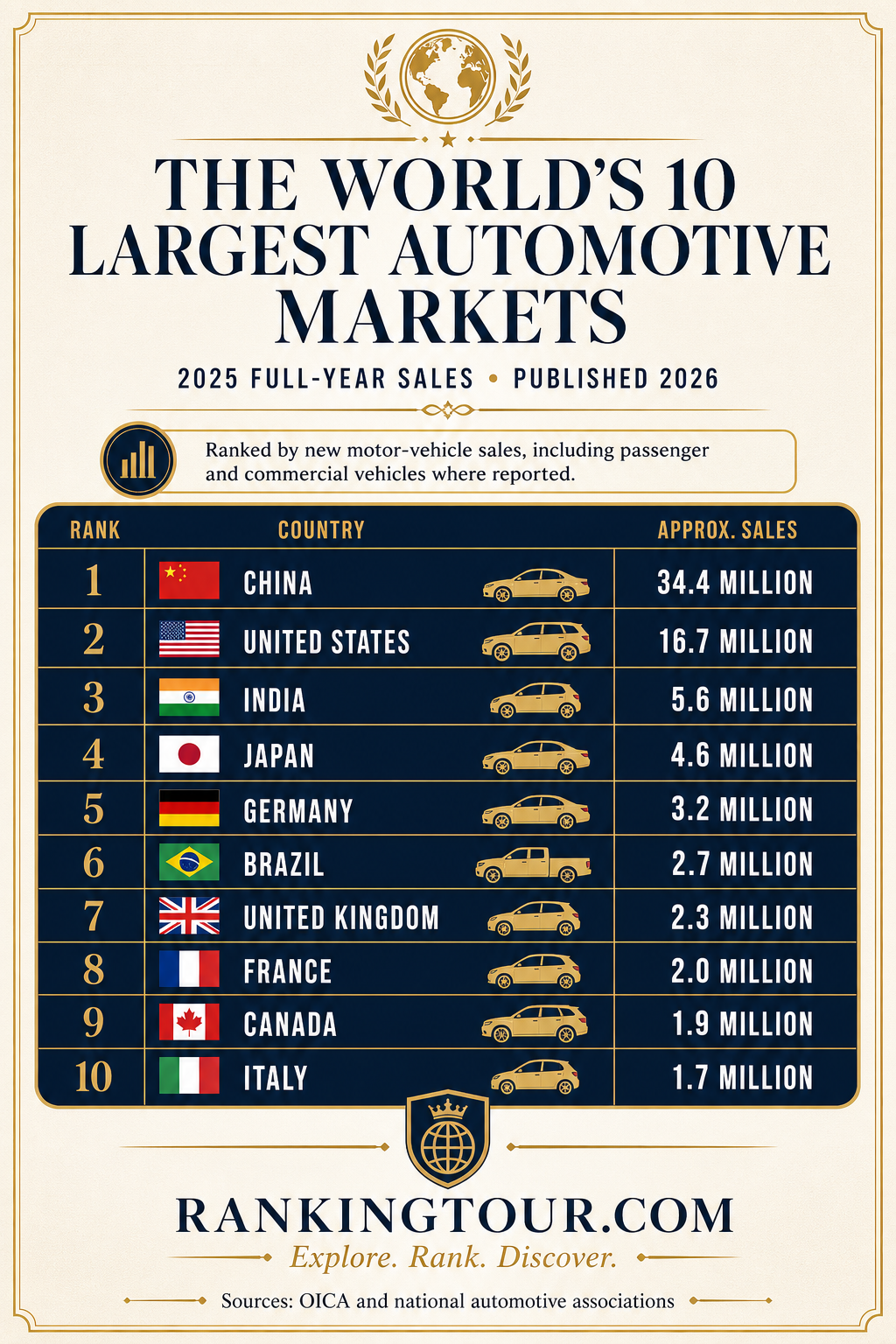
The world's largest automotive markets ranked by approximately 2025 new motor-vehicle sales.
Updated July 11, 2026. Which countries buy the most new vehicles? This RankingTour list ranks the world’s largest automotive markets using the latest complete calendar-year data available in 2026. The comparison is based on approximately 2025 new motor-vehicle sales, including passenger cars and commercial vehicles where reported.
China remains in a class of its own, while the United States holds a clear second place. India has moved firmly into the global top three, and the rest of the ranking shows how automotive demand is spreading across Asia, Europe and the Americas.
Top 10 Largest Automotive Markets in the World in 2026
| Rank | Country | Approx. 2025 sales | Market snapshot |
|---|---|---|---|
| 1 | China | 34.4 million | The world’s dominant vehicle market and the center of global EV scale. |
| 2 | United States | 16.7 million | A high-value market led by pickups, SUVs and crossovers. |
| 3 | India | 5.6 million | The fastest-rising major market, supported by population and income growth. |
| 4 | Japan | 4.6 million | A mature market with exceptional strength in hybrids and compact vehicles. |
| 5 | Germany | 3.2 million | Europe’s largest national vehicle market and a premium-car powerhouse. |
| 6 | Brazil | 2.7 million | Latin America’s biggest market, with strong flex-fuel and compact-vehicle demand. |
| 7 | United Kingdom | 2.3 million | A large import-oriented market with rapidly expanding electrified choices. |
| 8 | France | 2.0 million | A major European market shaped by compact cars, hybrids and EV policy. |
| 9 | Canada | 1.9 million | A light-truck and SUV-heavy market closely integrated with the United States. |
| 10 | Italy | 1.7 million | A diverse market where small cars remain unusually important. |
Methodology note: Figures are rounded because national reporting systems do not use perfectly identical definitions. Some report registrations, others industry sales or wholesale deliveries, and commercial-vehicle coverage can differ. The ranking follows the International Organization of Motor Vehicle Manufacturers (OICA) framework and is cross-checked against national automotive associations.
1. China — Approximately 34.4 Million Vehicles
China is not simply the world’s largest automotive market; it is larger than the United States and India combined. Its enormous scale supports intense competition among domestic brands, global manufacturers and a rapidly expanding network of battery and software suppliers.
China is also the decisive market for electrification. Battery-electric vehicles and plug-in hybrids have moved into the mainstream, led by companies such as BYD, Geely, SAIC, Chery and a long list of technology-focused challengers. At the same time, the market’s fierce price competition is pressuring margins and accelerating exports.
Why it matters: Product decisions made for China increasingly influence vehicle design, batteries, infotainment and pricing around the world.
2. United States — Approximately 16.7 Million Vehicles
The United States remains the world’s second-largest automotive market and one of its most profitable. Consumer preference is heavily tilted toward pickups, SUVs and crossovers, making vehicle mix just as important as unit volume.
The U.S. market also has an unusually large financing, leasing and used-vehicle ecosystem. Electric vehicles continue to grow as a strategic segment, although adoption varies greatly by state and policy uncertainty has made the transition less predictable than in China or parts of Europe.
Why it matters: The United States combines massive sales volume with high average vehicle prices and strong demand for large, feature-rich models.
3. India — Approximately 5.6 Million Vehicles
India has become one of the central growth stories in the global auto industry. OICA reported more than 4.6 million passenger-vehicle sales plus over one million trucks and buses in fiscal year 2025–26, underlining the depth of demand across both consumer and commercial segments.
Compact cars and small SUVs dominate, but buyers are steadily moving toward more premium features. Local manufacturing, a growing middle class, expanding road infrastructure and the need for commercial transport all support long-term growth.
Why it matters: India offers the strongest combination of large existing volume and substantial future headroom among the top markets.
4. Japan — Approximately 4.6 Million Vehicles
Japan is a mature market, but it remains one of the world’s largest and most technologically influential. Kei cars, compact vehicles and hybrids play major roles, reflecting dense cities, fuel-efficiency priorities and a distinctive regulatory environment.
Toyota, Honda, Suzuki, Nissan, Mazda and Subaru give domestic brands a powerful home-market position. Japan’s strength in hybrid technology continues to shape its transition toward lower-emission transport.
Why it matters: Japan proves that a mature market can remain globally important through engineering expertise, efficient vehicles and strong domestic brands.
5. Germany — Approximately 3.2 Million Vehicles
Germany is Europe’s largest national automotive market and the home base of Volkswagen Group, BMW and Mercedes-Benz. Passenger-car registrations account for most of the total, with commercial vehicles taking the overall market above three million units.
Electrification is changing the competitive landscape. German manufacturers are investing heavily in EV platforms and software while facing growing pressure from lower-cost imports and changing European emissions rules.
Why it matters: Germany combines large domestic demand with premium-brand influence and one of the world’s most important automotive manufacturing clusters.
6. Brazil — Approximately 2.7 Million Vehicles
Brazil is Latin America’s biggest automotive market. About 2.55 million light vehicles were sold in 2025, with trucks and buses lifting the total toward 2.7 million. Flexible-fuel vehicles remain an important feature because ethanol is deeply embedded in the country’s transport-energy system.
Demand is concentrated in compact cars, small SUVs and pickups, while Chinese brands are rapidly expanding their presence, especially in electrified vehicles.
Why it matters: Brazil is the region’s essential scale market and an important test of how EVs, hybrids and biofuels can coexist.
7. United Kingdom — Approximately 2.3 Million Vehicles
The United Kingdom registered roughly two million new passenger cars in 2025, with vans and other light vehicles taking the broader market to about 2.3 million. The country is especially important for premium brands, fleet sales and company-car demand.
Battery-electric registrations continue to rise, supported by a wide model range and fleet purchasing, although affordability and charging access remain important consumer concerns.
Why it matters: The UK is one of Europe’s largest and most open automotive markets, making it a critical launch market for new brands and technologies.
8. France — Approximately 2.0 Million Vehicles
France recorded about 1.63 million new passenger-car registrations in 2025. Adding around 358,000 light commercial vehicles puts the broader light-vehicle market close to two million units.
Renault, Peugeot, Citroën and Dacia remain central to the market, where compact cars, practical family vehicles and electrified powertrains are especially significant. New-car demand was softer in 2025, but France still belongs among the world’s ten largest markets.
Why it matters: France has a large consumer base, influential domestic brands and policy choices that affect the direction of the wider European market.
9. Canada — Approximately 1.9 Million Vehicles
Canadian new light-vehicle sales reached about 1.90 million units in 2025, according to DesRosiers Automotive Consultants. SUVs, crossovers and pickups dominate, reflecting geography, climate and close integration with North American vehicle platforms.
The market is deeply connected to U.S. manufacturing and trade policy, while provincial differences create a varied landscape for electric-vehicle adoption.
Why it matters: Canada is smaller than the United States but remains a high-income, high-value market with an important role in North American production.
10. Italy — Approximately 1.7 Million Vehicles
Italy completes the top ten with roughly 1.5 million passenger cars plus close to 190,000 light commercial vehicles. Small cars have historically held an unusually strong position because of urban density, narrow streets and ownership costs.
Hybrid registrations are rising, but the transition to fully electric vehicles has generally moved more slowly than in several northern European markets.
Why it matters: Italy remains one of Europe’s largest consumer markets and an important center for automotive design, components, commercial vehicles and premium performance brands.
What the 2026 Ranking Reveals
The biggest change in the global automotive map is the shift toward Asia. China is already dominant, India is climbing rapidly and Japan remains firmly in the top five. Europe still places four countries in the top ten, but its largest national markets are growing more slowly and navigating a difficult transition toward electrification.
The ranking also shows that market size is not the same as production. Mexico and South Korea are major manufacturing and export centers, for example, but their domestic sales volumes do not place them in this particular top ten. Conversely, the UK and Canada are large consumer markets even though much of what they buy is imported or produced within cross-border supply chains.
Sources and Notes
The principal reference is OICA’s World Motor Vehicle Sales 2025 and its 2025 global industry summary. Cross-checks include the European Automobile Manufacturers’ Association, the UK’s Society of Motor Manufacturers and Traders, Brazil’s ANFAVEA, and Canada’s 2025 market review. Figures are rounded and should be read as market-size estimates rather than perfectly harmonized registration counts.
About the Author