Evaluation Overview
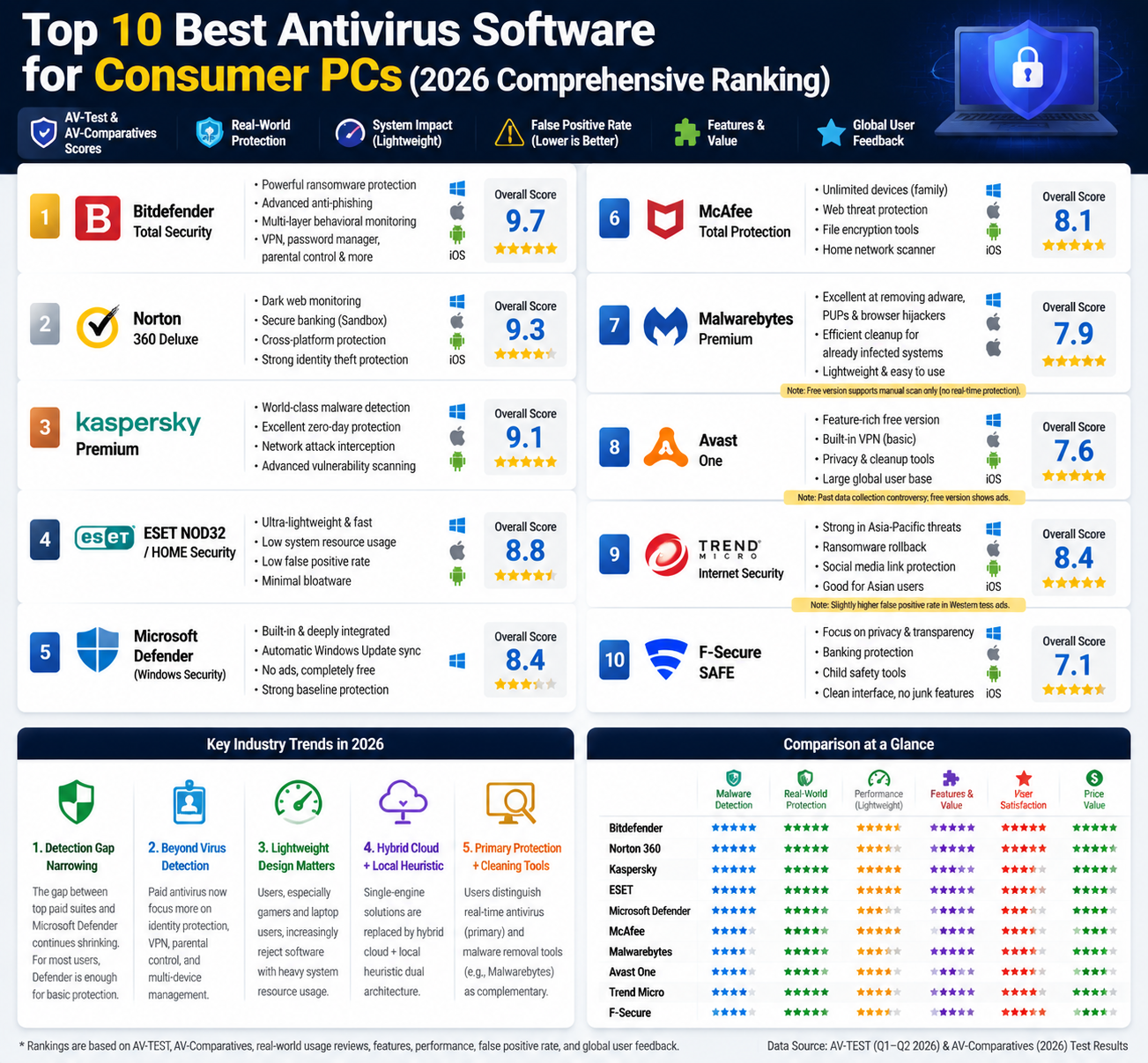
Ranking standard: Composite score based on AV-TEST & AV-Comparatives independent lab detection results, real-world threat protection, system resource overhead, false positive rate, feature completeness, global user feedback, free & paid version maturity.
Scope: Consumer personal PC security software (Windows primary, Mac compatible). Enterprise endpoint security excluded.
Data reference: Test reports Q1-Q2 2026.
Top 10 Ranking
1. Bitdefender Total Security
Consistently achieves near-perfect scores in independent global testing labs. Balanced performance with low system resource consumption.
Core strengths: Powerful ransomware defense, advanced anti-phishing, cloud heuristic scanning, multi-layer behavioral monitoring. Premium suite bundles VPN, password manager, parental control and anti-tracker.
Suitable for: Users pursuing top-tier all-round protection, family multi-device households.
2. Norton 360 Deluxe
Global mainstream consumer security leader with mature threat intelligence library. Excellent identity theft protection modules.
Core strengths: Dark web monitoring, secure banking sandbox, cross-platform unified protection, stable long-term detection capability. Widely recognized in North America and Western Europe.
Note: Higher background resource load compared to Bitdefender and ESET.
3. Kaspersky Premium
World-class malware detection engine, outstanding capability against zero-day threats and complex trojans.
Core strengths: Deep behavior analysis, vulnerability scanning, advanced network attack interception. Clean UI and flexible custom rules for advanced users.
Remark: Geopolitical restrictions limit official service in several regions.
4. ESET NOD32 Antivirus / ESET HOME Security
Famous for ultra-lightweight operation, minimal CPU & RAM usage, ideal for gaming laptops and low-spec PCs.
Core strengths: Excellent heuristic detection, low false positive ratio, long-term stable scanning speed. Less redundant bundled bloatware.
Suitable for: Gamers, lightweight device users, enthusiasts who hate system lag.
5. Microsoft Defender (Windows Security)
Free built-in solution for Windows 10/11, no extra installation required.
Core strengths: Deep OS integration, zero advertising, automatic Windows Update synchronization. Recent lab tests prove its baseline protection reaches the first-tier level of paid antivirus.
Limitations: Lacks extended features such as independent VPN, identity monitoring; prone to false alerts on cracked software and modified executables. No dedicated adware/PUP targeted cleaning.
6. McAfee Total Protection
Advantage: Unlimited device license options for family packages. Strong global channel coverage.
Core strengths: Web threat blocking, home network scanner, file encryption tools.
Weakness: Historical reputation of heavy system overhead; multiple users report frequent pop-up reminders.
7. Malwarebytes Premium
Positioned as complementary security software, outstanding at clearing adware, browser hijackers, PUPs which mainstream antivirus often overlook.
Core strengths: Specialized unwanted program detection, efficient cleanup for already infected systems.
Note: Free version only supports manual on-demand scanning without real-time background protection. Most users run it alongside primary antivirus.
8. Avast One
Large global free-user base. Integrated multiple auxiliary tools in one suite.
Core strengths: Feature-rich free tier, built-in basic VPN, privacy cleanup tools.
Controversy: Past data collection scandals; free edition contains advertisement prompts.
9. Trend Micro Internet Security
Top performance in Asia-Pacific regional threat capture, good at defending against local malware variants.
Core strengths: Ransomware rollback function, social media link protection. Balanced performance for Asian users.
Weakness: Slightly higher false positive rate in Western test environments.
10. F-Secure SAFE
Nordic security vendor, focus on privacy and transparent data policy.
Core strengths: Simple clean interface, reliable banking protection, child safety tools. No excessive system optimization junk functions. Popular among privacy-focused users in Europe.
Key Industry Trends 2026
- The gap of core malware detection capability between top paid suites and Microsoft Defender continues shrinking. For ordinary users with safe browsing habits, the built-in Defender meets basic demands.
- The main differentiation of paid antivirus gradually shifts from virus detection to identity protection, VPN, parental control, multi-device management rather than pure threat interception.
- Lightweight design becomes a critical competitive indicator; gamers and notebook users increasingly reject security software with high background occupation.
- Single-engine antivirus is being replaced by hybrid cloud + local heuristic dual architecture.
- Users gradually distinguish primary real-time antivirus and auxiliary malware cleaning tools (represented by Malwarebytes).
Important Methodology Notes
- This composite ranking weights real-world protection test results higher than static malware sample detection.
- Scores consider both paid full suites and free versions; software with aggressive advertising, forced pop-ups get deduction.
- Performance test environment: Standard Windows 11 consumer platform. Actual resource occupancy varies with hardware specifications and custom settings.
- No antivirus can achieve 100% threat interception. Security software is only one layer of protection; safe download and browsing behavior remain fundamental.
About the Author