Artificial intelligence has become the most important growth engine in the global semiconductor industry.
AI chips now power large language models, cloud data centers, autonomous vehicles, smartphones, AI PCs and industrial automation. While NVIDIA remains the dominant supplier of AI accelerators, competition is increasing rapidly as AMD, Broadcom, Google, Amazon, Huawei and other companies develop specialized chips for training and inference.
Unlike a conventional semiconductor revenue ranking, this RankingTour list evaluates companies according to their overall influence in the AI chip industry.
Ranking Criteria
The ranking considers:
- AI accelerator revenue and shipment scale
- Data-center training and inference performance
- Software ecosystem and developer adoption
- Cloud and enterprise deployment
- Custom AI chip capabilities
- Customer relationships
- On-device and edge AI influence
- Long-term technological competitiveness
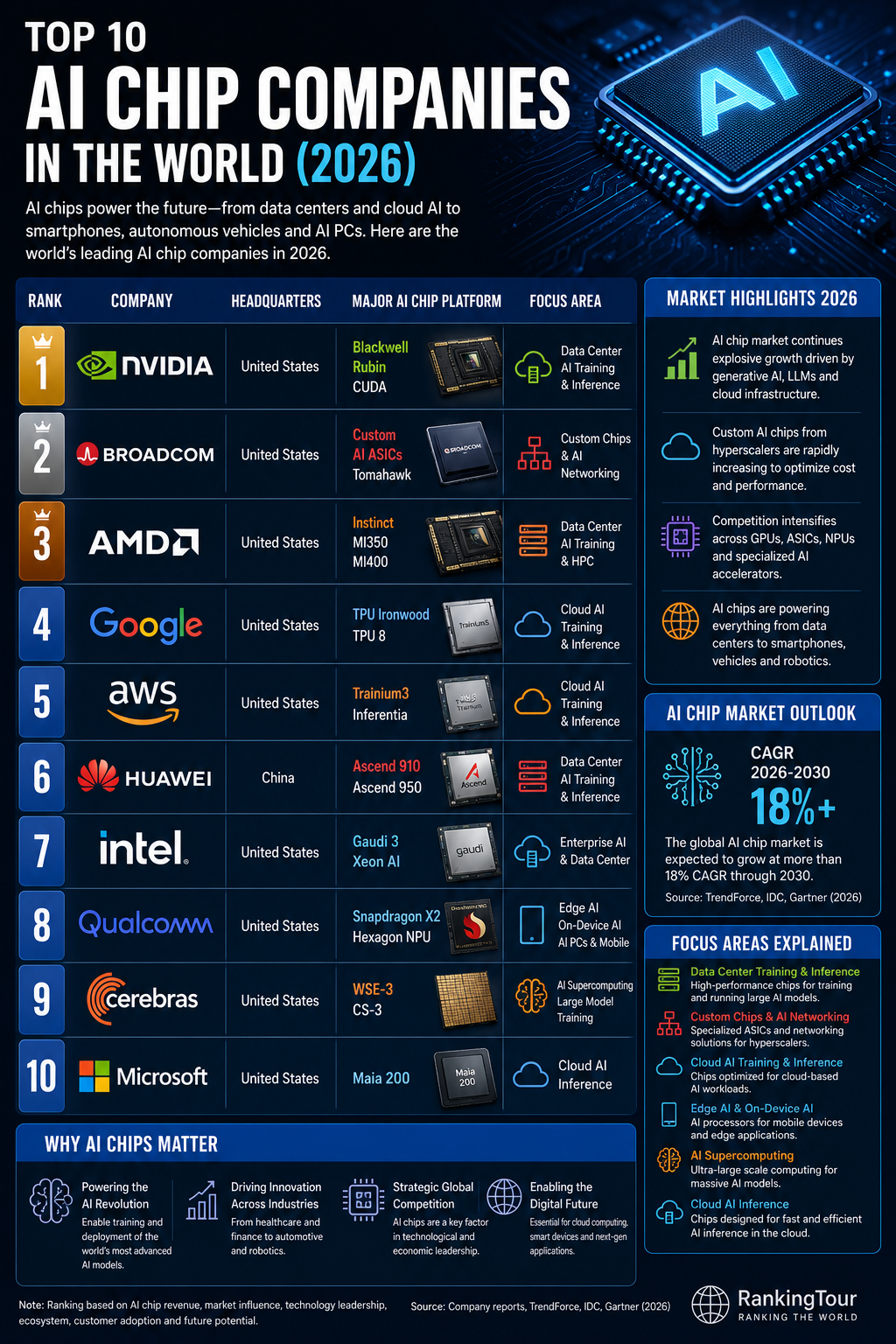
Top 10 AI Chip Companies in the World (2026)
| Rank | Company | Headquarters | Major AI Chip Platform |
|---|---|---|---|
| 1 | NVIDIA | United States | Blackwell, Rubin, CUDA |
| 2 | Broadcom | United States | Custom AI ASICs, AI Networking |
| 3 | AMD | United States | Instinct MI350, MI400 |
| 4 | United States | TPU Ironwood, TPU 8 | |
| 5 | Amazon Web Services | United States | Trainium3, Inferentia |
| 6 | Huawei | China | Ascend 910, Ascend 950 |
| 7 | Intel | United States | Gaudi 3, Xeon AI |
| 8 | Qualcomm | United States | Snapdragon X2, Hexagon NPU |
| 9 | Cerebras Systems | United States | WSE-3, CS-3 |
| 10 | Microsoft | United States | Maia 200 |
1. NVIDIA
NVIDIA remains the undisputed leader of the global AI chip market in 2026.
Its data-center GPUs are widely used to train and run the world’s largest generative AI models. NVIDIA’s greatest advantage is not only its hardware performance, but also the CUDA software ecosystem, networking products, developer tools and complete AI infrastructure platform.
NVIDIA reported fiscal 2026 revenue of US$215.9 billion, an increase of 65% from the previous year. Data-center revenue increased 68%, reflecting continued demand for AI computing infrastructure.
Core Strengths
- Dominant global AI accelerator supplier
- Industry-leading CUDA software ecosystem
- Blackwell and Rubin GPU platforms
- Strong networking and interconnect products
- Broad adoption among cloud providers and AI companies
Best Known For
Large-scale AI training, generative AI inference, high-performance computing and AI supercomputers.
2. Broadcom
Broadcom has become one of the most strategically important AI semiconductor companies through custom accelerators and high-speed networking.
Unlike NVIDIA, Broadcom does not mainly sell general-purpose GPUs. Instead, it works with hyperscale technology companies to design custom AI ASICs optimized for specific workloads.
Broadcom’s AI semiconductor revenue increased sharply during fiscal 2025, driven by custom accelerators and Ethernet networking products. The company projected AI semiconductor revenue of US$8.2 billion for the first quarter of fiscal 2026, while later reporting continued rapid growth in its AI business.
Core Strengths
- Custom AI accelerator design
- Hyperscaler customer relationships
- Ethernet AI networking
- High-speed interconnect technology
- Strong long-term AI order pipeline
Best Known For
Custom chips used by major cloud and internet companies.
3. AMD
AMD is NVIDIA’s most important direct competitor in the merchant GPU market.
Its Instinct accelerator family is designed for large-scale AI training and inference, while its EPYC server processors remain widely used in cloud data centers.
AMD’s data-center revenue reached a record US$16.6 billion in 2025, up 32%, supported by growth in EPYC CPUs and Instinct GPU shipments.
Core Strengths
- Strong alternative to NVIDIA GPUs
- Instinct MI350 and MI400 platforms
- Competitive high-bandwidth memory capacity
- EPYC CPU and GPU integration
- Growing cloud and enterprise customer adoption
Best Known For
Data-center GPUs, AI training, inference and high-performance computing.
4. Google
Google is one of the pioneers of custom AI accelerators.
Its Tensor Processing Unit, or TPU, was specifically developed for machine-learning workloads and has evolved through multiple generations. Google uses TPUs internally for Gemini and other AI services while also offering them to Google Cloud customers.
Google’s seventh-generation Ironwood TPU became generally available in March 2026. Ironwood supports large-scale training and inference and can scale to 9,216 chips per pod. Google also introduced eighth-generation TPU systems designed to improve training performance per dollar.
Core Strengths
- Long history of custom AI chip development
- Tight integration with Google Cloud
- Optimized for Gemini and large AI models
- Highly scalable TPU supercomputers
- Strong JAX and machine-learning software ecosystem
Best Known For
Cloud AI training, inference and Google’s internal AI services.
5. Amazon Web Services
Amazon Web Services has emerged as a major custom AI chip developer through its Trainium and Inferentia platforms.
Trainium is designed for AI training, while Inferentia is optimized for low-cost inference. AWS uses these chips to reduce dependence on external GPU suppliers and offer cloud customers alternative AI infrastructure.
Trainium3 became available in late 2025 as AWS’s first 3nm AI chip. AWS also operates Project Rainier, a massive AI cluster powered by nearly 500,000 Trainium2 chips.
Core Strengths
- Deep integration with AWS cloud services
- Strong price-performance positioning
- Trainium for training
- Inferentia for inference
- Large-scale hyperscale deployments
Best Known For
Cost-efficient cloud AI training and inference.
6. Huawei
Huawei is China’s most important AI chip and computing-platform company.
Its Ascend processors have become a strategic alternative to NVIDIA products in China, particularly as U.S. export controls restrict access to advanced American AI accelerators.
Huawei has developed complete AI systems combining Ascend processors, Atlas servers, SuperPoD clusters and the MindSpore software framework.
By the end of 2025, Huawei’s Ascend ecosystem had attracted more than four million developers, while more than 350 partners had launched Ascend-based AI products.
Core Strengths
- Leading Chinese AI accelerator ecosystem
- Ascend AI processors
- Atlas SuperPoD systems
- Strong domestic customer base
- Integrated hardware and software platform
Best Known For
China-based AI infrastructure, training clusters and enterprise AI systems.
7. Intel
Intel remains an influential AI semiconductor company despite facing intense competition in the accelerator market.
The company’s Gaudi 3 platform targets enterprise generative AI training and inference, while Intel Xeon processors continue to play a central role in AI data centers.
Gaudi 3 became available through major enterprise infrastructure partners, including Dell and IBM Cloud. Intel positions the platform as an open and cost-efficient alternative to proprietary GPU systems.
Core Strengths
- Large enterprise customer base
- Gaudi AI accelerator platform
- Xeon server ecosystem
- Open Ethernet-based scaling
- Strong CPU and accelerator integration
Best Known For
Enterprise AI, server processors and lower-cost accelerator alternatives.
8. Qualcomm
Qualcomm is one of the global leaders in edge and on-device AI.
Rather than focusing mainly on large data-center training systems, Qualcomm integrates neural processing units into smartphones, laptops, vehicles and embedded devices.
The Snapdragon X2 Elite platform features an NPU capable of up to 80 TOPS, strengthening Qualcomm’s position in the emerging AI PC market.
Core Strengths
- Mobile and edge AI leadership
- Snapdragon AI processors
- High-efficiency Hexagon NPUs
- Strong smartphone and laptop ecosystem
- Low-power on-device inference
Best Known For
AI smartphones, AI PCs, automotive computing and edge devices.
9. Cerebras Systems
Cerebras has developed one of the most distinctive architectures in the AI chip industry.
Instead of using many small chips, Cerebras builds wafer-scale processors. Its WSE-3 chip measures 46,225 square millimeters and contains approximately four trillion transistors.
The company’s CS-3 systems are designed for large-model training and high-speed inference and can scale to models containing trillions of parameters.
Core Strengths
- Wafer-scale processor architecture
- Extremely large on-chip memory
- High-speed AI inference
- Simplified large-model scaling
- Specialized AI supercomputer systems
Best Known For
Wafer-scale AI computing and ultra-fast inference.
10. Microsoft
Microsoft entered the custom AI accelerator market to improve the economics of AI workloads running on Azure.
Its second-generation Maia 200 accelerator was introduced in January 2026 and focuses primarily on large-scale AI inference.
The chip is manufactured using a 3nm process and includes 216 GB of HBM3e memory with 7 TB/s of bandwidth. Microsoft says Maia 200 delivers 30% better performance per dollar than its previous internal systems.
Core Strengths
- Deep Azure integration
- Optimized for AI inference
- Designed for Microsoft AI workloads
- High-memory architecture
- Reduces dependence on third-party GPUs
Best Known For
Azure-based AI inference and Microsoft’s internal AI services.
Why NVIDIA Still Leads
NVIDIA’s advantage is larger than hardware performance alone.
The company controls a highly developed ecosystem that includes:
- CUDA
- AI libraries
- Developer tools
- Networking products
- Complete server systems
- Enterprise software
- Cloud partnerships
Competitors may offer strong individual chips, but replacing NVIDIA often requires companies to rewrite software, retrain engineers and redesign data-center infrastructure.
This ecosystem creates a powerful competitive barrier.
Custom AI Chips Are Becoming More Important
Google, Amazon, Microsoft and other hyperscalers are developing their own chips because custom silicon can reduce costs and improve efficiency for specific workloads.
General-purpose GPUs remain highly flexible, but custom ASICs can be optimized for:
- Transformer training
- AI inference
- Recommendation systems
- Video generation
- Search
- Advertising
- Internal cloud workloads
Broadcom has become a major beneficiary of this trend by helping large technology companies design custom AI accelerators.
Data-Center AI Versus Edge AI
Not every company competes in the same part of the AI chip market.
Data-Center Leaders
- NVIDIA
- Broadcom
- AMD
- Amazon
- Huawei
- Intel
- Cerebras
- Microsoft
Edge and On-Device AI Leaders
- Qualcomm
- Apple
- MediaTek
- Samsung
- NVIDIA
Qualcomm ranks highly because billions of smartphones, laptops and connected devices increasingly require local AI processing without sending every task to the cloud.
Key Takeaways
- NVIDIA remains the clear global leader in AI accelerators.
- Broadcom has become the leading force in custom hyperscaler AI chips.
- AMD is the strongest merchant GPU competitor to NVIDIA.
- Google and Amazon are rapidly expanding proprietary AI chip platforms.
- Huawei is the leading AI accelerator supplier within China.
- Qualcomm dominates important areas of mobile and edge AI.
- Cerebras offers one of the most innovative alternatives to conventional GPU architecture.
- Microsoft’s Maia 200 signals growing competition among cloud companies developing their own chips.
- Custom AI ASICs are likely to capture a larger share of future AI infrastructure spending.
- Software ecosystems and customer adoption are now as important as raw chip performance.
Methodology
This ranking is not based solely on semiconductor revenue or market capitalization.
RankingTour evaluated each company according to:
- AI chip revenue and commercial scale
- Global customer adoption
- Data-center and cloud deployments
- Training and inference capabilities
- Software ecosystem maturity
- Custom-chip design expertise
- Edge AI influence
- Product roadmap
- Strategic importance to the global AI industry
Because companies disclose AI chip revenue differently, direct financial comparisons are not always possible. Google, Amazon and Microsoft primarily use their custom chips within their own cloud ecosystems, while NVIDIA, AMD, Intel and Cerebras sell products to external customers.
About the Author