Overview
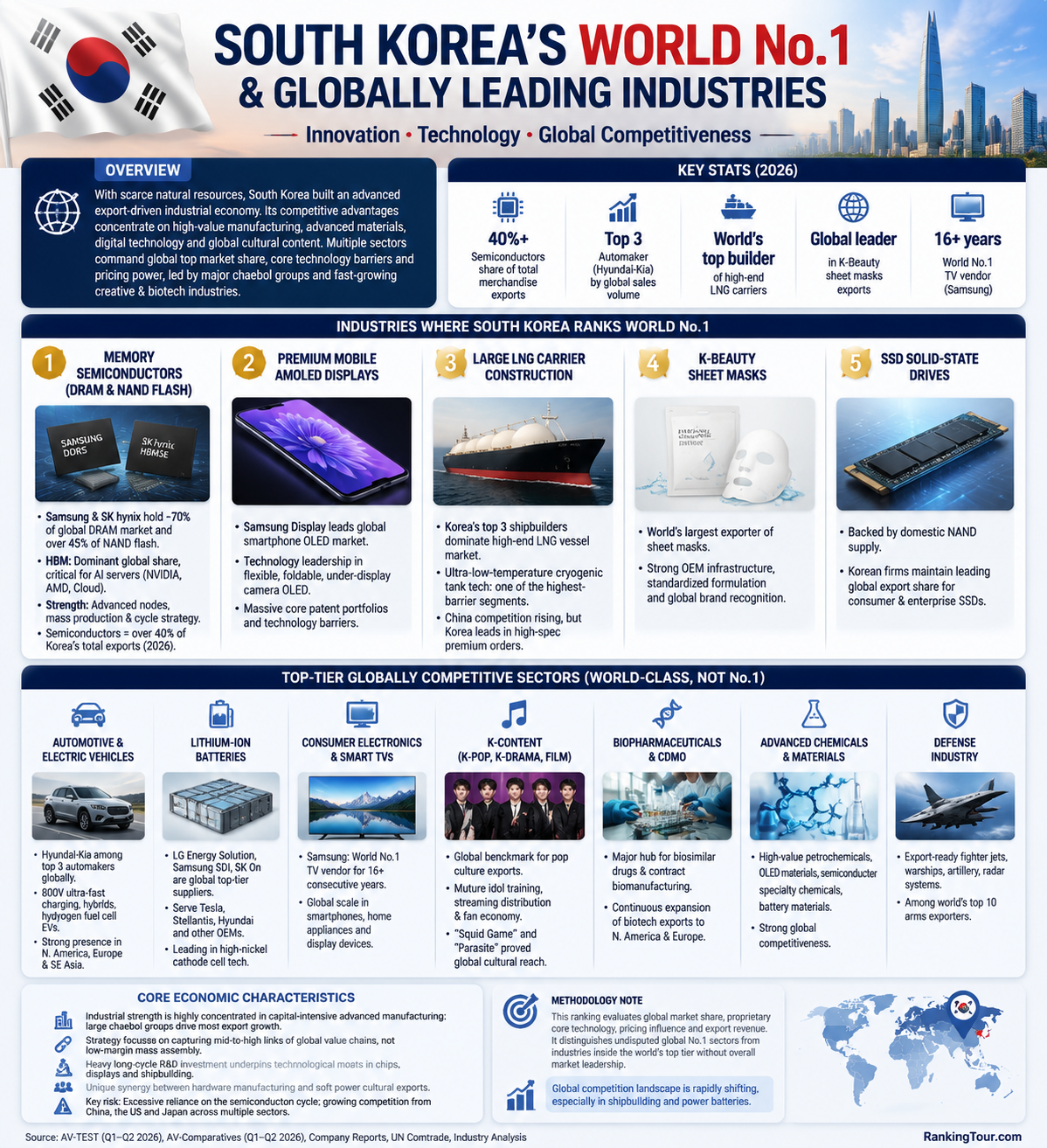
With scarce natural resources, South Korea built an advanced export-driven industrial economy. Its competitive advantages concentrate on high-value manufacturing, advanced materials, digital technology and global cultural content. Multiple sectors command global top market share, core technology barriers and pricing power. The economy features concentrated leadership by major chaebol groups, alongside fast-growing creative and biotech industries.
Industries Where South Korea Ranks World No.1
1. Memory Semiconductors (DRAM & NAND Flash)
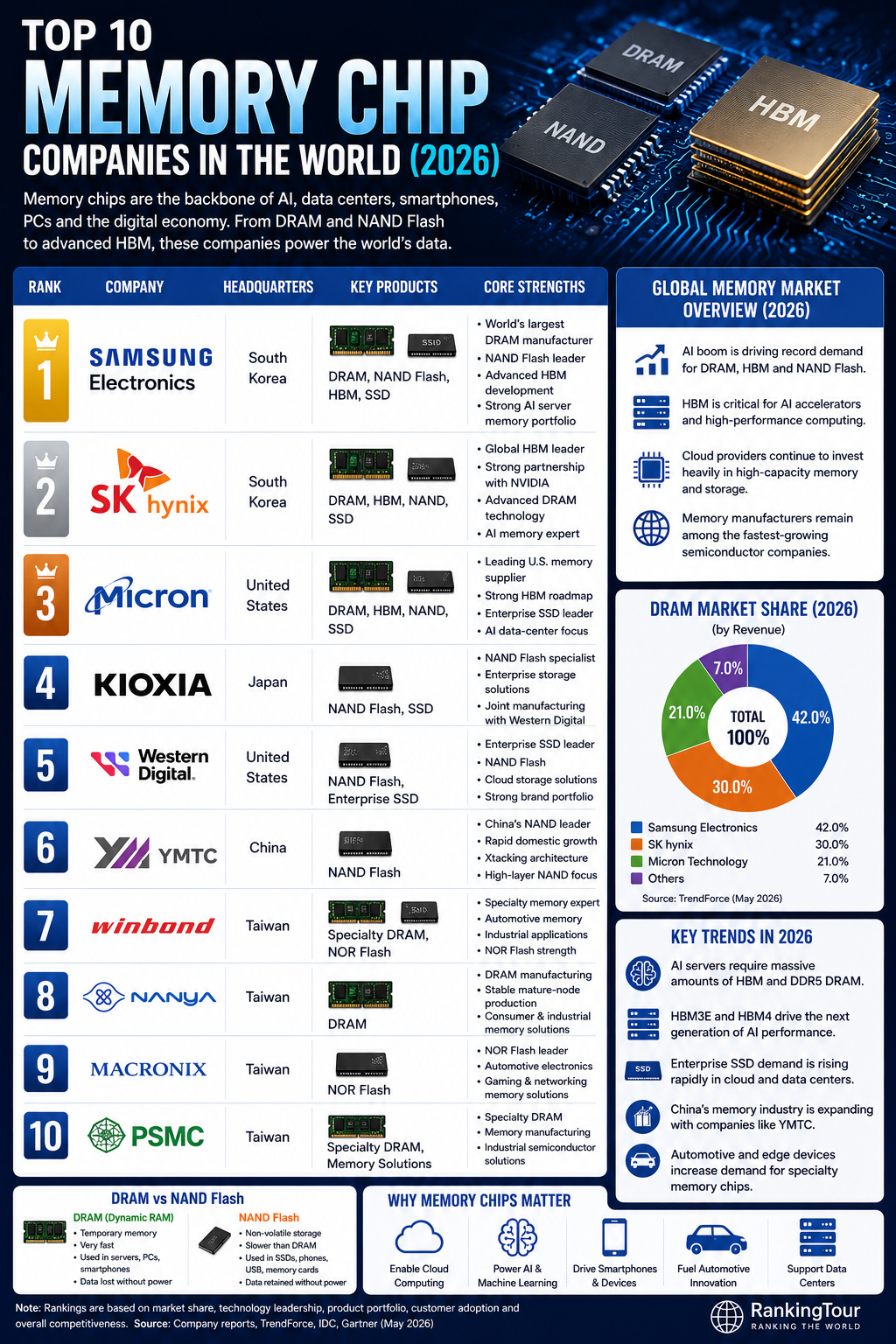
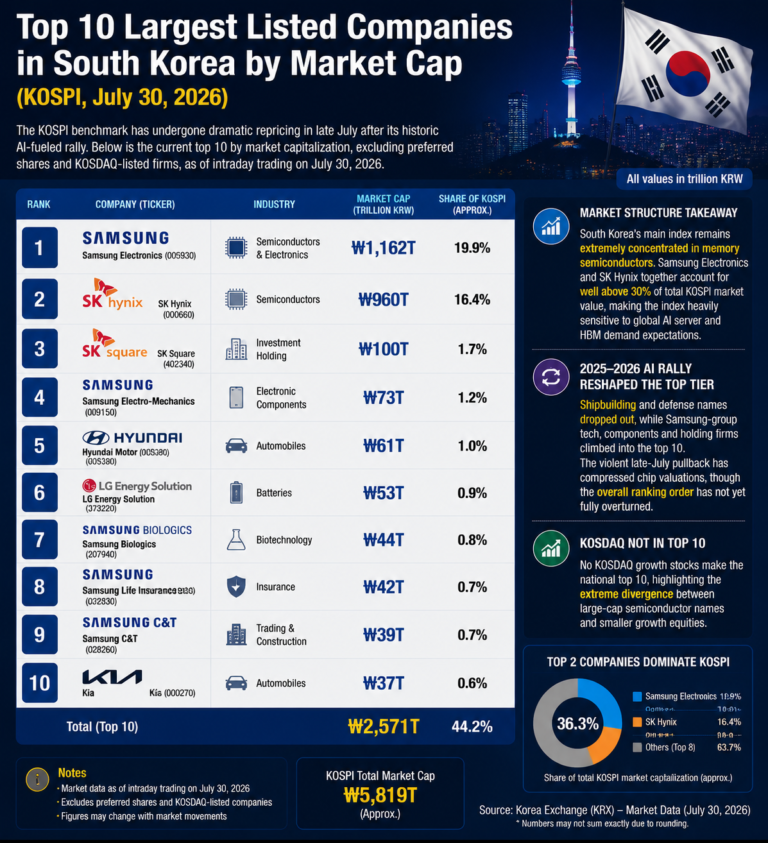
Samsung Electronics and SK hynix jointly control roughly 70% of the global DRAM market and over 45% of NAND flash supply.
- HBM (High Bandwidth Memory): Korea holds dominant global market share. HBM is critical hardware for AI servers, with Korean suppliers serving NVIDIA, AMD and major cloud operators.
- Core strength: Advanced process nodes, mass production capacity and cycle management strategy.
- Economic weight: Semiconductors account for over 40% of Korea’s total merchandise exports (2026).
2. Premium Mobile AMOLED Displays
Samsung Display leads the global smartphone OLED panel market, supplying flagship devices for Apple, Samsung and other global brands.
Korea retains technology supremacy in flexible, foldable and under-display camera OLED technologies, owning massive core patent portfolios.
3. Large LNG Carrier Construction
South Korea’s three major shipbuilders dominate the high-end liquefied natural gas vessel market. LNG carriers require ultra-low-temperature cryogenic cargo tank technology, one of the highest-barrier segments in global shipbuilding.
Note: Competition from Chinese shipyards has intensified in recent years, but Korea still leads in high-spec premium orders.
4. K-Beauty Sheet Masks
Korea is the world’s largest exporter of sheet masks, with standardized formulation, OEM infrastructure and global brand recognition.
5. SSD Solid-State Drives
Supported by domestic NAND supply, Korean manufacturers maintain long-term leading global export share for consumer and enterprise SSDs.
Top-Tier Globally Competitive Sectors (World-Class, not No.1)
Automotive & Electric Vehicles
Hyundai-Kia ranks among the world’s top 3 automakers by sales volume.
Core strengths: 800V ultra-fast charging EV platform, hybrid powertrains, hydrogen fuel cell vehicles and strong overseas manufacturing networks. Robust presence in North America, Europe and Southeast Asia.
Secondary Lithium-ion Batteries
LG Energy Solution, Samsung SDI and SK On belong to the global top-tier battery suppliers, serving Tesla, Stellantis, Hyundai and other OEMs. Leading in high-nickel cathode cell technology.
Consumer Electronics & Smart TVs
Samsung Electronics has maintained the world’s No.1 television vendor position for over 16 consecutive years. Global scale in smartphones, home appliances and display devices.
K-Content (K-pop, K-Drama, Film)
Global benchmark for commercial pop culture exports. Built mature idol training systems, streaming distribution and fan economy models. Works such as Squid Game and Oscar-winning Parasite proved global cultural reach.
Biopharmaceuticals & CDMO
Korea is a major hub for biosimilar drugs and contract biomanufacturing. Continuous expansion of biotech exports to North America and Europe.
Advanced Chemicals & Materials
High-value petrochemical products, OLED raw materials, semiconductor specialty chemicals and battery materials maintain strong global competitiveness.
Defense Industry
Export-ready fighter jets, warships, artillery and radar systems. Korea ranks among the world’s top 10 arms exporters.
Core Economic Characteristics
- Industrial strength is highly concentrated in capital-intensive advanced manufacturing; large chaebol groups carry most export growth.
- Strategy focuses on capturing mid-to-high links of global value chains instead of low-margin mass assembly.
- Heavy long-cycle R&D investment underpins technological moats in chips, displays and shipbuilding.
- Unique synergy between hardware manufacturing and soft power cultural exports.
- Key risk: Excessive reliance on the semiconductor cycle; growing competition from China, the US and Japan across multiple sectors.
Methodology Note
This ranking evaluates global market share, proprietary core technology, pricing influence and export revenue. It distinguishes undisputed global No.1 sectors from industries inside the world’s top tier without overall market leadership. Global competition landscape is rapidly shifting, especially in shipbuilding and power batteries.
About the Author