Meta Description:Ranking of the world’s top 10 largest AI-related companies by market capitalization in 2026. AI chips, cloud computing, foundation models and on-device AI drive global market valuations.
Artificial intelligence has evolved from an experimental technology into the primary growth engine reshaping global public market valuations in 2026. This ranking tracks AI-related firms: listed enterprises with substantial revenue, product lines or long-term business strategy tied to AI compute, large language models, cloud AI infrastructure, semiconductor manufacturing, enterprise AI software and consumer AI ecosystems.
The list excludes private AI labs and pure startups, relying on public market capitalization as of mid-2026. Valuations reflect investor bets on AI chip supply, model deployment capacity, enterprise AI adoption and scalable AI monetization, rather than just pure AI software revenue.
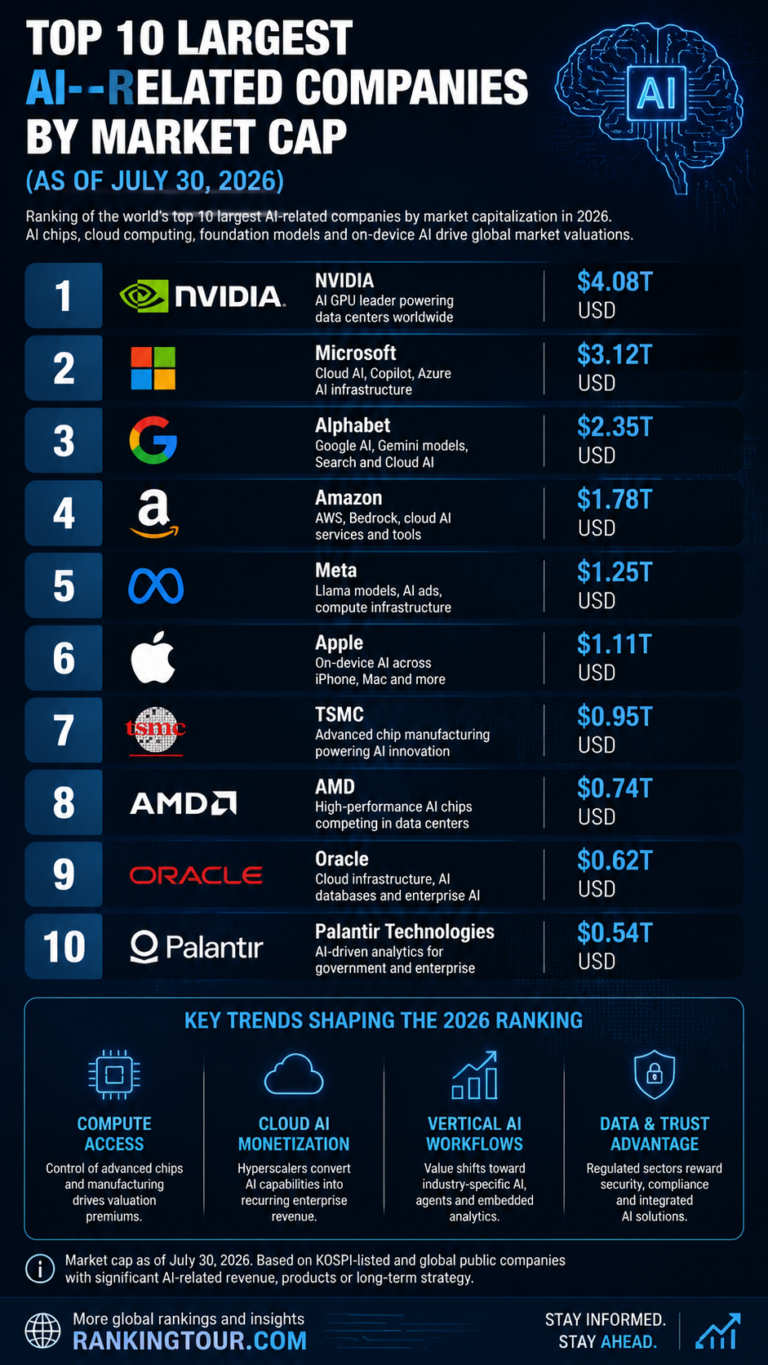
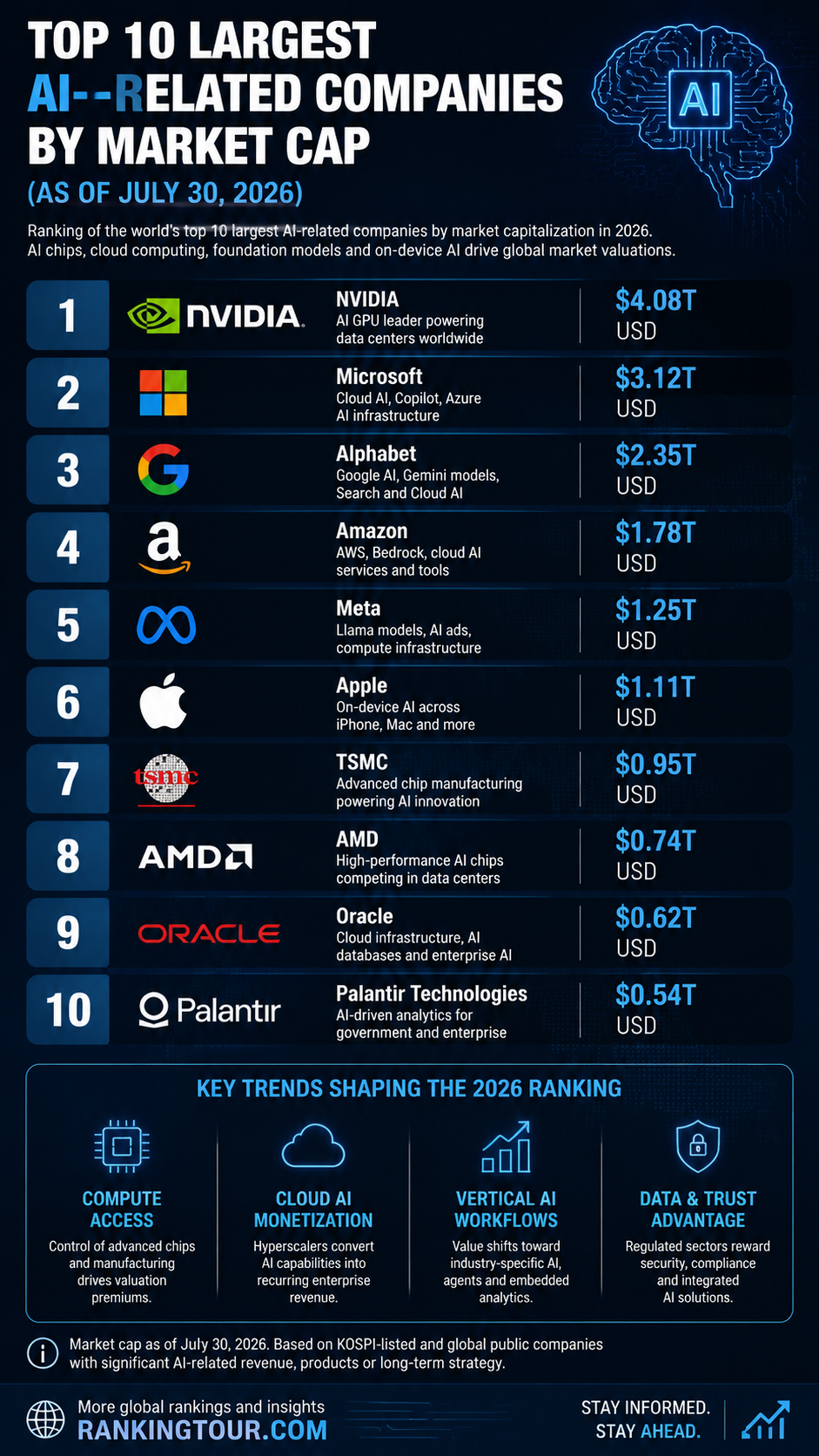
Below is the current top 10 largest AI-related companies by market cap:
NUMBER 1. NVIDIA
NUMBER 2. Microsoft
NUMBER 3. Alphabet
NUMBER 4. Amazon
NUMBER 5. Meta
NUMBER 6. Apple
NUMBER 7. TSMC
NUMBER 8. AMD
NUMBER 9. Oracle
NUMBER 10. Palantir Technologies
Why This AI-Related Hierarchy Matters
The 2026 ranking underscores a simple reality: the biggest AI value pools sit in infrastructure and distribution, not only foundation model research.
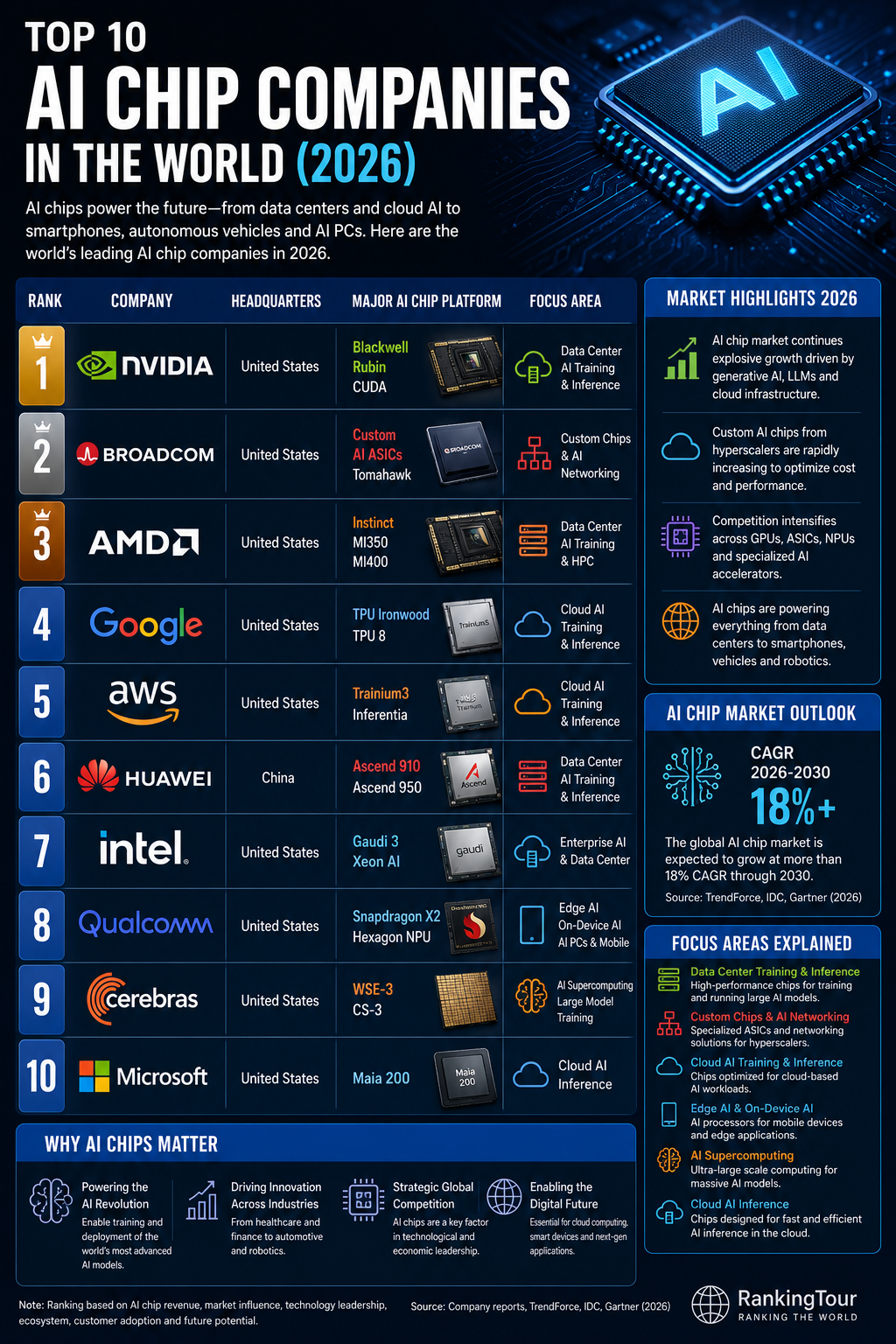
NVIDIA retains its lead as the core supplier of data center GPUs that power nearly all frontier model training and inference workloads. TSMC and AMD ride the same structural demand wave, as advanced silicon manufacturing and competing AI accelerators become bottlenecks for global AI expansion.
Cloud hyperscalers Microsoft, Alphabet and Amazon turn AI into recurring enterprise spending. They package LLMs, vector databases, AI agents, custom fine-tuning tools and secure cloud environments into long-term contracts, converting AI hype into predictable revenue. Meta’s open-model strategy lowers deployment barriers for businesses while lifting demand for its own compute stack and advertising AI systems.
Consumer hardware and vertical enterprise software fill the next tier. Apple pushes on-device AI across its hardware ecosystem, shifting AI value from cloud servers to end-user devices. Oracle and Palantir target regulated sectors including finance, government and healthcare, where data security, compliance and integrated operational AI carry premium valuations.
Key Trends Shaping the 2026 Ranking
Two dynamics are reshaping market caps: compute access and monetization proof. Companies with stable access to advanced manufacturing and power-efficient silicon hold valuation premiums. Firms that can clearly separate AI-driven revenue from legacy business lines are less exposed to sentiment swings during market pullbacks.
Value is gradually moving beyond generic foundation models toward vertical AI workflows, industry-specific agents and embedded analytics. This benefits companies with existing enterprise customer bases, proprietary data pipelines and regulated industry trust—not only teams building generic large models.
What Market Cap Cannot Measure
Market capitalization is a noisy metric. It does not equal technical superiority, startup innovation, research talent or sustainable profit margins. Many influential AI labs, chip design firms and regional vertical AI players remain private and are excluded. The ranking also underrepresents strong Asian and European AI-related public companies whose global investor visibility is still growing.
Closing View
The world’s largest AI-related companies in 2026 are a mix of chipmakers, cloud platforms, hardware ecosystems and enterprise software vendors. As AI moves from pilot projects into core business operations, the valuation gap between infrastructure gatekeepers and pure-play AI software firms may keep widening. Investors are increasingly rewarding businesses that control both the silicon supply chain and the customer workflows AI is built into.
About the Author