The United Nations is funded through a combination of mandatory assessed contributions and voluntary donations from its member states.
For the UN regular budget, each country is assigned a contribution rate based largely on its capacity to pay. The formula considers factors such as national income, debt burden and income per person. A maximum assessment ceiling of 22% applies to any single country.
The assessment scale adopted by the UN General Assembly for 2025–2027 places the United States and China far ahead of every other member state.
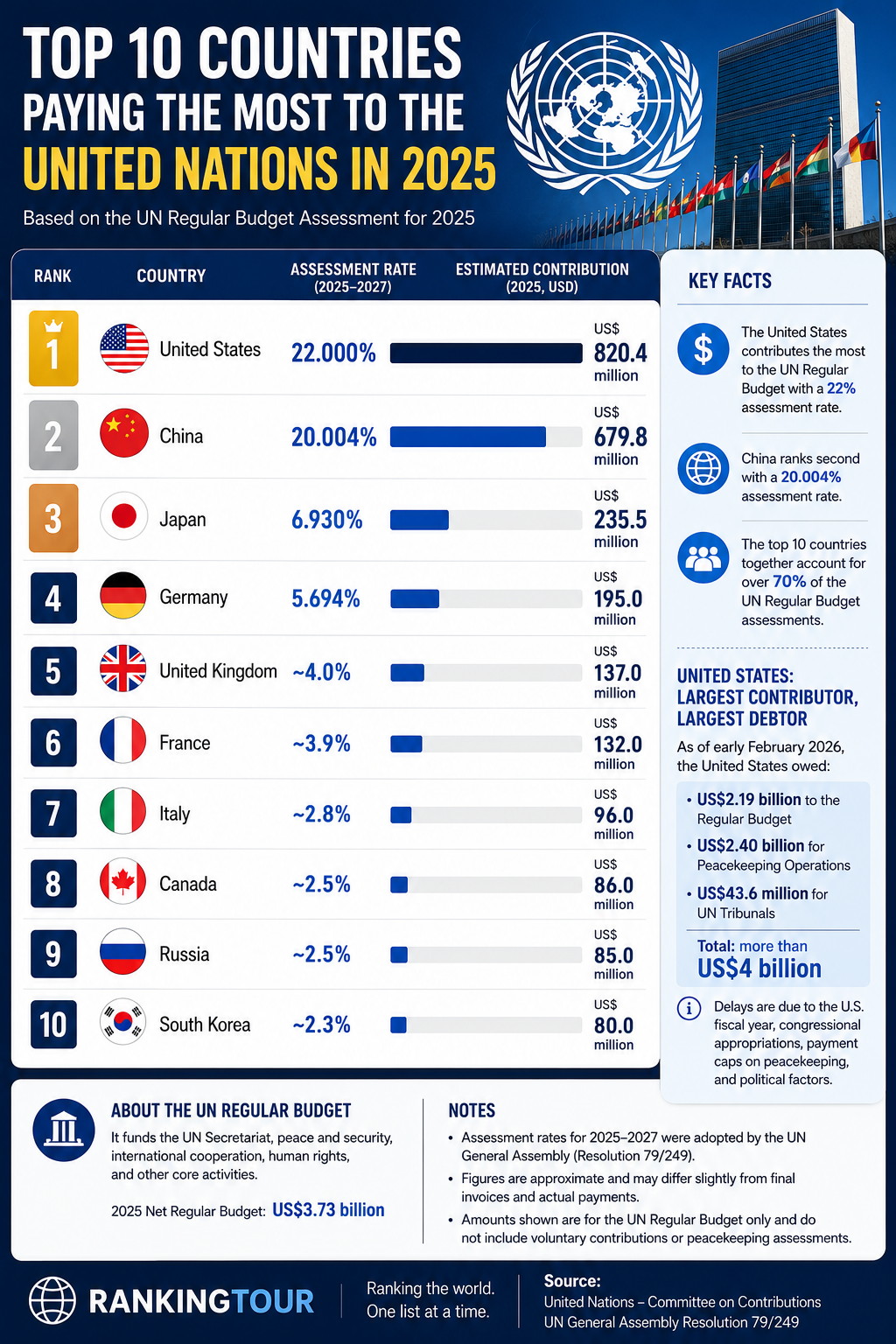
Top 10 Contributors to the UN Regular Budget in 2025
| Rank | Country | Assessment Rate | Approximate 2025 Assessment |
|---|---|---|---|
| 1 | United States | 22.000% | US$820.4 million |
| 2 | China | 20.004% | US$679.8 million |
| 3 | Japan | 6.930% | US$235.5 million |
| 4 | Germany | 5.694% | Approximately US$195 million |
| 5 | United Kingdom | Around 4.0% | Approximately US$137 million |
| 6 | France | Around 3.9% | Approximately US$132 million |
| 7 | Italy | Around 2.8% | Approximately US$96 million |
| 8 | Canada | Around 2.5% | Approximately US$86 million |
| 9 | Russia | Around 2.5% | Approximately US$85 million |
| 10 | South Korea | Around 2.3% | Approximately US$80 million |
The figures above refer to assessments for the UN regular budget. They do not include voluntary donations, humanitarian assistance, specialized UN agencies or the separately assessed peacekeeping budget.
1. United States
Assessment rate: 22.000%
The United States remains the largest assessed contributor to the UN regular budget. Its estimated 2025 obligation was approximately US$820.4 million.
The 22% rate is the maximum contribution ceiling allowed under the UN assessment system. Without this ceiling, the United States’ calculated share based on economic capacity could be even higher.
2. China
Assessment rate: 20.004%
China ranked second, with an estimated regular-budget assessment of approximately US$679.8 million in 2025.
China’s share has risen substantially over the past two decades as its economy has expanded. The gap between China and the United States is now much smaller than it was in previous assessment periods.
3. Japan
Assessment rate: 6.930%
Japan remained the third-largest contributor, with an estimated assessment of approximately US$235.5 million.
Although Japan’s share has gradually declined as other economies have grown, it continues to contribute far more than most UN member states.
4. Germany
Assessment rate: 5.694%
Germany was the largest European contributor to the UN regular budget, with an obligation of roughly US$195 million.
Germany is also a major voluntary donor to humanitarian, development and refugee-related UN programs.
5. United Kingdom
Assessment rate: approximately 4.0%
The United Kingdom ranked fifth, with a regular-budget assessment of approximately US$137 million.
As a permanent member of the UN Security Council, the UK is assessed at a higher rate for peacekeeping operations than for the regular budget.
6. France
Assessment rate: approximately 3.9%
France was assessed approximately US$132 million for the regular budget.
Like the United Kingdom, France is a permanent Security Council member and therefore carries an additional financial responsibility for UN peacekeeping missions.
7. Italy
Assessment rate: approximately 2.8%
Italy remained one of the largest European contributors, with an estimated regular-budget obligation of around US$96 million.
8. Canada
Assessment rate: approximately 2.5%
Canada’s estimated contribution was approximately US$86 million.
Canada also provides significant voluntary funding to UN humanitarian, health and development programs, which is separate from its mandatory contribution.
9. Russia
Assessment rate: approximately 2.5%
Russia ranked among the top 10 assessed contributors, with an estimated regular-budget obligation of around US$85 million.
As a permanent member of the Security Council, Russia’s peacekeeping assessment rate is higher than its regular-budget rate.
10. South Korea
Assessment rate: approximately 2.3%
South Korea entered the group of the largest UN contributors as its economy and international role expanded.
Its estimated 2025 regular-budget assessment was close to US$80 million.
Does the United States Owe Money to the United Nations?
Yes.
The United States is simultaneously the UN’s largest assessed contributor and its largest debtor.
By early February 2026, the United States owed approximately:
- US$2.19 billion to the UN regular budget
- US$2.4 billion for current and previous peacekeeping operations
- US$43.6 million for UN tribunals
This placed the total amount owed at more than US$4 billion.
The United States subsequently made a partial payment of approximately US$160 million, but this covered only a small portion of the outstanding balance.
At the beginning of February 2026, the United States accounted for more than 95% of all outstanding regular-budget dues owed by UN member states.
Why Does the United States Frequently Pay Late?
Several factors contribute to the recurring arrears.
Different fiscal calendars
The UN budget follows the calendar year from January to December, while the US federal fiscal year begins in October. This difference has historically caused some US payments to arrive later than the UN expects.
Congressional funding decisions
UN payments must be approved through the US federal budget process. Political disagreements, spending caps and delays in congressional appropriations can prevent payments from being made on time.
Peacekeeping payment cap
The UN assesses the United States for more than 25% of peacekeeping costs, but US law has often capped payments at 25%. The difference can accumulate as unpaid arrears.
Political pressure
US administrations and lawmakers have occasionally delayed or withheld funding to pressure the UN to reduce costs, change policies or carry out institutional reforms.
Can a Country Lose Its UN Voting Rights for Not Paying?
Under Article 19 of the UN Charter, a country can lose its vote in the General Assembly when its unpaid assessments equal or exceed the amount it should have paid during the previous two full years.
However, the General Assembly may allow the country to continue voting when the non-payment is caused by circumstances beyond its control.
Despite its large arrears, the United States has generally made enough payments to avoid crossing the threshold that would automatically suspend its General Assembly voting rights.
Regular Budget Versus Peacekeeping Budget
The UN regular budget and peacekeeping budget are separate.
The regular budget finances areas such as:
- The UN Secretariat
- Political missions
- International diplomacy
- Human rights work
- Legal and administrative operations
Peacekeeping operations are funded through a different assessment system. Permanent members of the Security Council pay a larger share because they hold special responsibility for authorizing peacekeeping missions.
For 2025, the largest peacekeeping assessment rates included:
- United States — 26.158%
- China — 23.785%
- Japan — 6.930%
- Germany — 5.694%
- United Kingdom — approximately 4.0%
Key Takeaways
- The United States was responsible for 22% of the UN regular budget in 2025.
- China followed closely with a 20.004% assessment rate.
- The United States and China together were responsible for more than 42% of regular-budget assessments.
- Japan remained the third-largest contributor but was far behind the two leading countries.
- The United States is both the largest assessed contributor and the largest debtor to the UN.
- US arrears exceeded US$4 billion in early 2026 when regular-budget, peacekeeping and tribunal obligations were combined.
- Mandatory assessments should not be confused with voluntary donations to UN agencies and humanitarian programs.
Methodology and Sources
This ranking is based on the United Nations scale of assessments adopted for the 2025–2027 period and the net UN regular-budget assessments reported for 2025.
Approximate dollar amounts may differ slightly from final invoices and actual payments because of credits, adjustments, working-capital requirements and payment timing.
Primary sources: United Nations Committee on Contributions, UN General Assembly Resolution 79/249, UN payment records and Reuters reporting on outstanding US dues.
About the Author