The world’s highest mountains represent some of the most breathtaking and challenging natural landmarks on Earth. Located primarily in the Himalayas and Karakoram mountain ranges, these giants attract climbers, adventurers, and nature enthusiasts from around the globe.
Among them, Mount Everest remains the undisputed highest point on Earth, while K2 is widely regarded as the most difficult mountain to climb among the world’s tallest peaks.
🏆 Top 10 Highest Mountains in the World
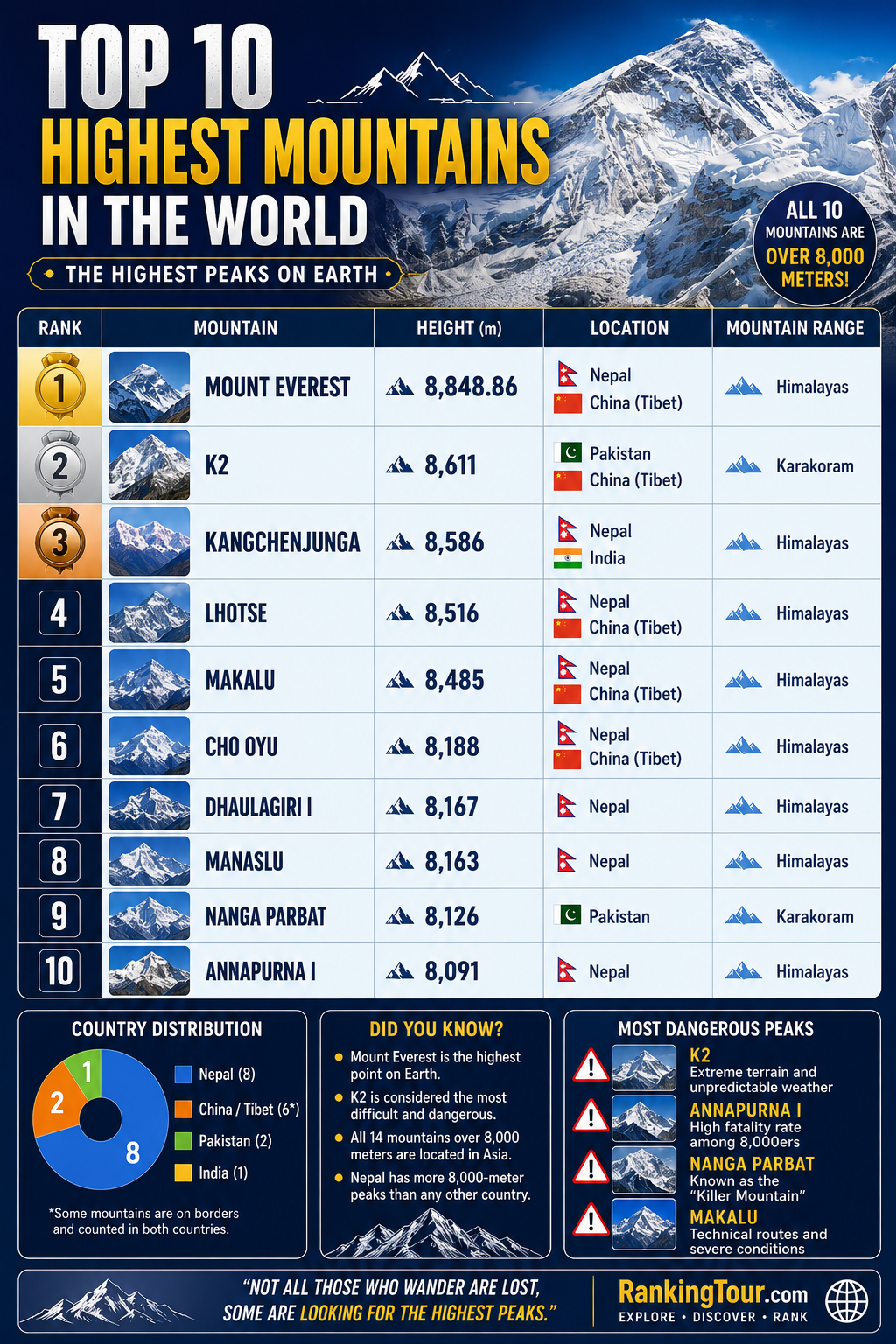
| Rank | Mountain | Height (m) | Country / Region |
|---|---|---|---|
| 🥇 1 | Mount Everest | 8,848.86 | Nepal / China |
| 🥈 2 | K2 | 8,611 | Pakistan / China |
| 🥉 3 | Kangchenjunga | 8,586 | Nepal / India |
| 4 | Lhotse | 8,516 | Nepal / China |
| 5 | Makalu | 8,485 | Nepal / China |
| 6 | Cho Oyu | 8,188 | Nepal / China |
| 7 | Dhaulagiri I | 8,167 | Nepal |
| 8 | Manaslu | 8,163 | Nepal |
| 9 | Nanga Parbat | 8,126 | Pakistan |
| 10 | Annapurna I | 8,091 | Nepal |
🌟 Top 3 Highest Mountains
🥇 Mount Everest (8,848.86m)
Located on the border of Nepal and Tibet (China), Mount Everest is the highest mountain on Earth. Its official height was jointly confirmed by Nepal and China in 2020 at 8,848.86 meters.
Key Facts:
- Highest point on Earth
- First climbed in 1953
- Part of the Himalayas
- Known locally as Sagarmatha (Nepal) and Chomolungma (Tibet)
🥈 K2 (8,611m)
K2 is the second-highest mountain in the world but is often considered the most difficult and dangerous of all 8,000-meter peaks.
Key Facts:
- Located in the Karakoram Range
- Nicknamed “The Savage Mountain”
- One of the highest fatality rates among major peaks
- More technically challenging than Everest
🥉 Kangchenjunga (8,586m)
Located on the border of Nepal and India, Kangchenjunga is the third-highest mountain in the world.
Key Facts:
- Name means “Five Treasures of Snow”
- Sacred mountain in local culture
- One of the least-climbed peaks among the world’s highest mountains
🌍 Geographic Distribution
| Country / Region | Mountains in Top 10 |
|---|---|
| Nepal | 8 |
| China (Tibet) | 6* |
| Pakistan | 2 |
| India | 1 |
Several mountains are located on international borders and are counted in multiple countries.
The Himalayas were formed by the collision of the Indian and Eurasian tectonic plates, a process that continues today.
⚠️ Most Dangerous Mountains in the Top 10
Some of the world’s highest mountains are also among the deadliest:
K2
Extremely steep terrain and unpredictable weather.
Annapurna I
Historically one of the highest fatality-rate mountains among the 8,000-meter peaks.
Nanga Parbat
Known as the “Killer Mountain” due to its difficult climbing conditions.
Makalu
Highly technical climbing routes and severe weather conditions.
📊 Interesting Facts
- All 14 mountains higher than 8,000 meters are located in Asia.
- Nepal hosts more 8,000-meter peaks than any other country.
- Mount Everest grows slightly taller every year due to tectonic activity.
- K2 was not successfully climbed in winter until 2021.
- Annapurna I has one of the most challenging summit routes in the world.
🏔️ Why These Mountains Matter
The world’s highest peaks are more than just climbing destinations. They are:
- Important freshwater sources
- Key climate indicators
- Cultural and spiritual landmarks
- Major tourism destinations
- Symbols of human endurance and exploration
Millions of people depend on Himalayan glacier systems fed by these mountains.
🏁 Conclusion
The world’s Top 10 highest mountains represent the ultimate challenge for mountaineers and some of the most spectacular natural wonders on Earth. From the towering summit of Mount Everest to the deadly slopes of K2 and Annapurna, these mountains continue to inspire adventurers and explorers from every corner of the globe.
As technology and climbing techniques advance, these legendary peaks remain enduring symbols of nature’s power and beauty.
About the Author