Rare earth elements (REEs) have become some of the most strategically important minerals in the modern economy. Despite their name, rare earth elements are not necessarily scarce — their challenge lies in finding economically extractable deposits and developing the technology required for processing.
These 17 metallic elements are essential for advanced technologies including electric vehicles (EVs), smartphones, wind turbines, renewable energy systems, aerospace equipment, defense technologies, and high-performance magnets.
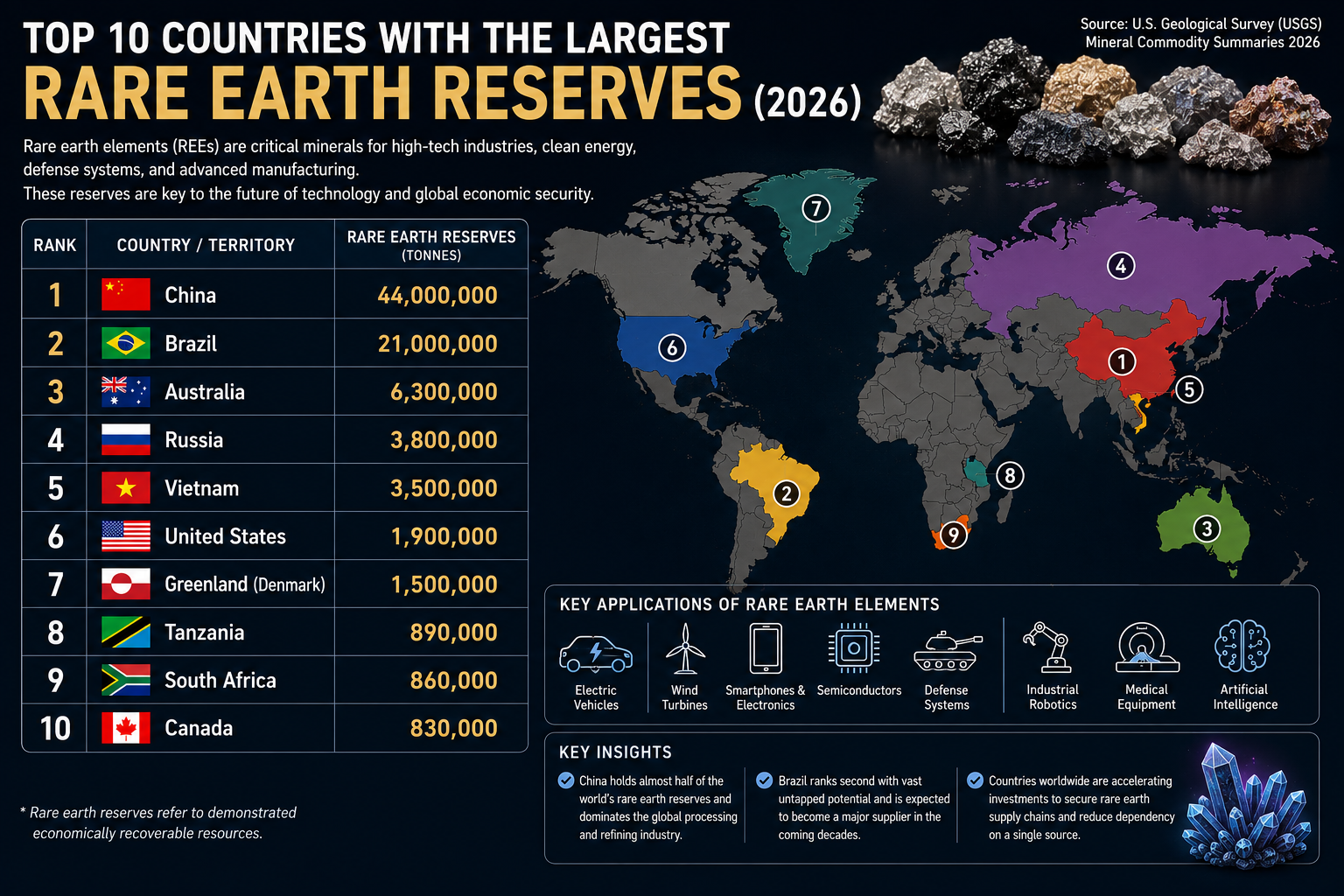
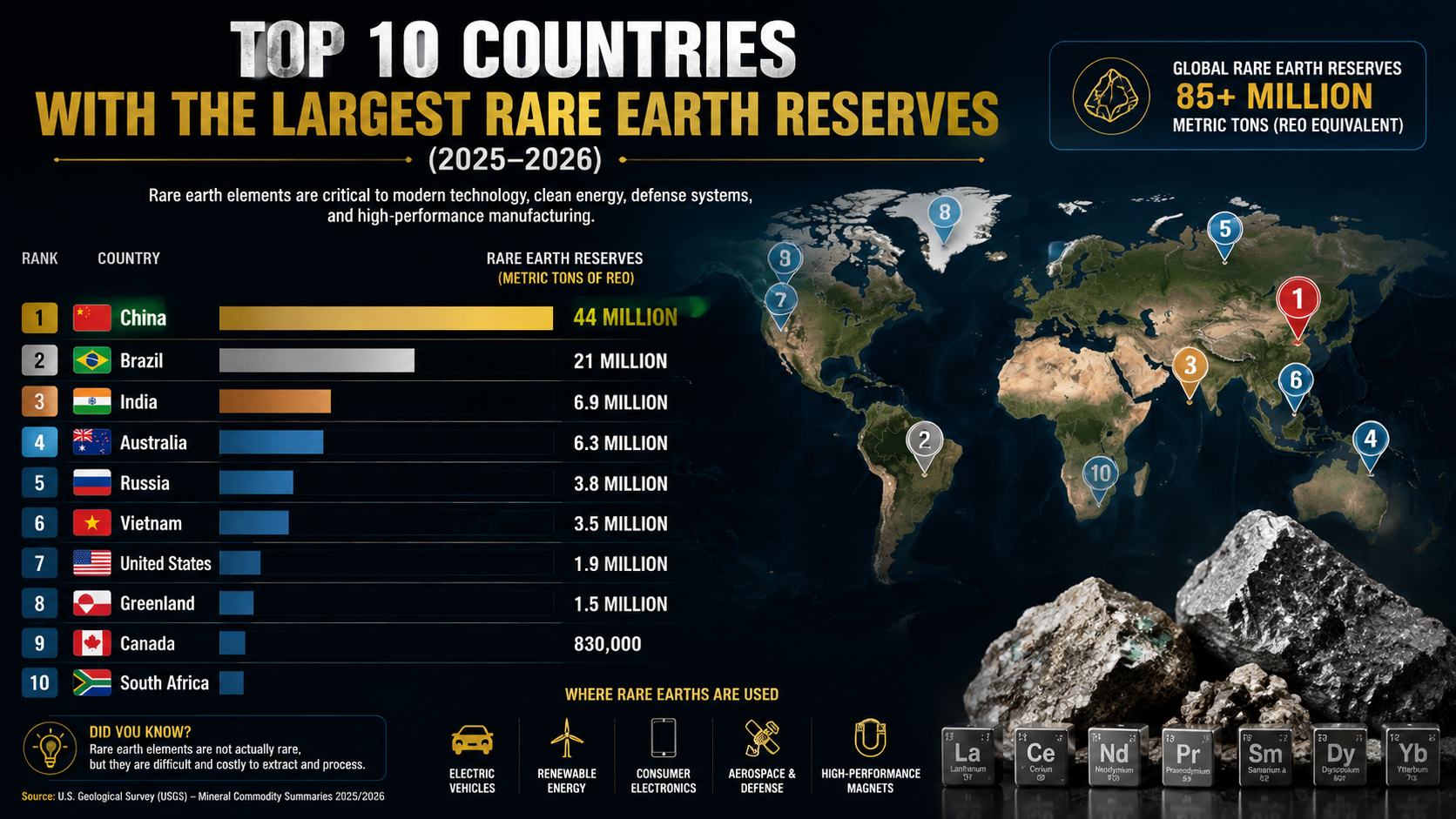
According to the latest estimates from the U.S. Geological Survey (USGS), global rare earth reserves exceed 85 million metric tons of rare earth oxide (REO) equivalent, with China holding the world’s largest known reserves.
Here are the Top 10 Countries With The Largest Rare Earth Reserves in the World (2025–2026).
Top 10 Rare Earth Reserves by Country (2025–2026)
| Rank | Country | Rare Earth Reserves |
|---|---|---|
| 1 | China 🇨🇳 | 44 million metric tons |
| 2 | Brazil 🇧🇷 | 21 million metric tons |
| 3 | India 🇮🇳 | 6.9 million metric tons |
| 4 | Australia 🇦🇺 | 6.3 million metric tons |
| 5 | Russia 🇷🇺 | 3.8 million metric tons |
| 6 | Vietnam 🇻🇳 | 3.5 million metric tons |
| 7 | United States 🇺🇸 | 1.9 million metric tons |
| 8 | Greenland 🇬🇱 | 1.5 million metric tons |
| 9 | Canada 🇨🇦 | 830,000 metric tons |
| 10 | South Africa 🇿🇦 | 860,000 metric tons |
10. South Africa 🇿🇦 — 860,000 Metric Tons
South Africa has significant rare earth potential linked to its diverse mineral resources. While its current rare earth production remains limited, the country is considered strategically important because of its broader mining expertise and access to critical minerals.
9. Canada 🇨🇦 — 830,000 Metric Tons
Canada has become increasingly focused on developing its critical mineral industry. The country possesses important rare earth deposits, particularly in regions such as Quebec and the Northwest Territories.
Canada’s stable mining environment and proximity to North American markets make it an attractive alternative supply source.
8. Greenland 🇬🇱 — 1.5 Million Metric Tons
Greenland holds some of the world’s largest undeveloped rare earth deposits.
The island’s rare earth resources have attracted international attention because of their potential role in reducing dependence on concentrated supply chains.
7. United States 🇺🇸 — 1.9 Million Metric Tons
The United States has significant rare earth reserves, mainly centered around the Mountain Pass mine in California.
Although the U.S. has resources, the country remains dependent on international processing capacity, particularly for refining and permanent magnet manufacturing.
6. Vietnam 🇻🇳 — 3.5 Million Metric Tons
Vietnam possesses some of the largest rare earth reserves in Southeast Asia.
The country has been exploring opportunities to expand mining and processing capabilities as global companies seek alternatives to existing supply chains.
5. Russia 🇷🇺 — 3.8 Million Metric Tons
Russia has large rare earth deposits spread across its vast territory.
However, limited production capacity and geopolitical challenges have prevented Russia from becoming a major global supplier.
4. Australia 🇦🇺 — 6.3 Million Metric Tons
Australia is one of the world’s most important rare earth producers outside China.
The country benefits from advanced mining infrastructure and has become a key partner for countries seeking diversified rare earth supply chains.
3. India 🇮🇳 — 6.9 Million Metric Tons
India possesses the third-largest rare earth reserves globally.
Its deposits are mainly found along coastal mineral sands, but production remains relatively small compared with its resource potential due to processing and technological limitations.
2. Brazil 🇧🇷 — 21 Million Metric Tons
Brazil has the world’s second-largest known rare earth reserves.
Despite its enormous resource base, commercial production remains limited. The country is increasingly viewed as a future major player in the global rare earth market as governments and companies seek alternatives to China’s dominance.
1. China 🇨🇳 — 44 Million Metric Tons
China ranks first worldwide with approximately 44 million metric tons of rare earth reserves.
Beyond reserves, China dominates the global rare earth supply chain through mining, refining, separation technology, and permanent magnet manufacturing.
China’s advantage is not only the size of its deposits but also its highly developed processing ecosystem, which plays a critical role in global technology industries.
Why Are Rare Earth Elements So Important?
Rare earth elements are essential components in many modern technologies:
🚗 Electric Vehicles
- High-performance permanent magnets
- EV motors
- Battery-related technologies
🌎 Renewable Energy
- Wind turbine generators
- Solar technology components
📱 Consumer Electronics
- Smartphones
- Computers
- Audio equipment
🛰 Aerospace & Defense
- Missile guidance systems
- Satellites
- Advanced radar systems
The Future of the Global Rare Earth Industry
The global competition for rare earth resources is expected to intensify as demand increases for electric vehicles, artificial intelligence infrastructure, renewable energy, and defense technologies.
While China currently dominates the industry, countries including Brazil, Australia, India, Vietnam, Canada, and the United States are investing in new projects to build more diversified supply chains.
The future rare earth race will not only depend on who owns the largest deposits, but also who can successfully develop mining, refining, and manufacturing capabilities.
Summary: Top 10 Countries With The Largest Rare Earth Reserves
| Rank | Country | Reserves |
|---|---|---|
| 🥇 1 | China | 44M tons |
| 🥈 2 | Brazil | 21M tons |
| 🥉 3 | India | 6.9M tons |
| 4 | Australia | 6.3M tons |
| 5 | Russia | 3.8M tons |
| 6 | Vietnam | 3.5M tons |
| 7 | United States | 1.9M tons |
| 8 | Greenland | 1.5M tons |
| 9 | Canada | 830K tons |
| 10 | South Africa | 860K tons |
About the Author