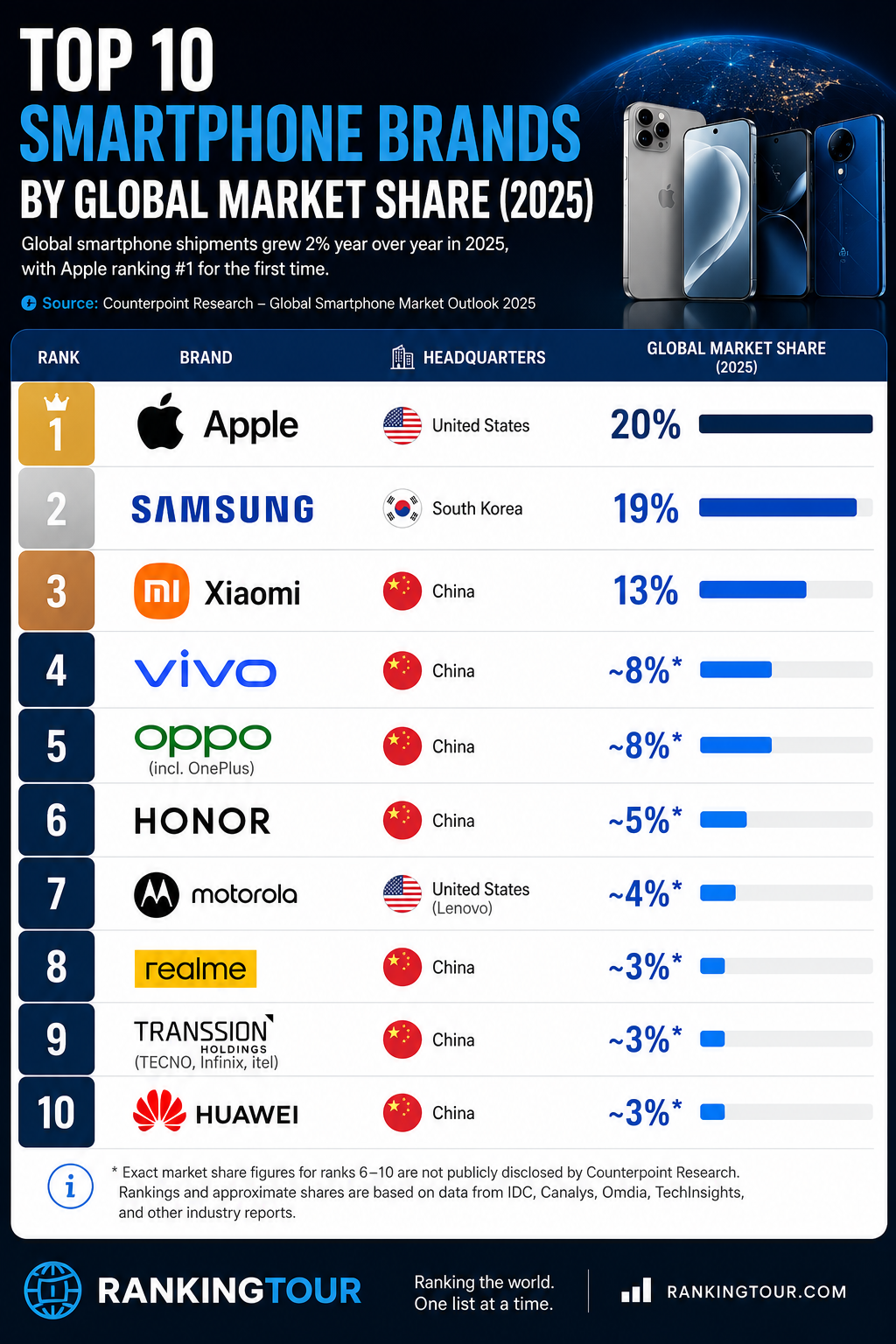
The global smartphone market returned to growth in 2025, with worldwide shipments increasing 2% year over year. Premium devices, stronger demand in emerging markets, and AI-powered smartphones helped drive the recovery. Apple finished the year as the world’s largest smartphone brand by market share, narrowly ahead of Samsung, while Chinese manufacturers continued expanding their global presence.
Top 10 Smartphone Brands by Global Market Share (2025)
| Rank | Brand | Headquarters | Global Market Share |
|---|---|---|---|
| 🥇 1 | Apple | United States | 20% |
| 🥈 2 | Samsung | South Korea | 19% |
| 🥉 3 | Xiaomi | China | 13% |
| 4 | vivo | China | ~8%* |
| 5 | OPPO (incl. OnePlus) | China | ~8%* |
| 6 | Honor | China | ~5%* |
| 7 | Motorola | United States (Lenovo) | ~4%* |
| 8 | realme | China | ~3%* |
| 9 | Transsion (TECNO, Infinix, itel) | China | ~3%* |
| 10 | Huawei | China | ~3%* |
Note: Counterpoint Research publicly released exact market-share figures only for the top five brands. The rankings and approximate shares for positions 6–10 are based on the combined assessment of IDC, Canalys, Omdia, TechInsights, and other industry reports.
1. Apple 🇺🇸 — 20%
Apple became the world’s largest smartphone brand in 2025 with a 20% global market share. Growth was driven by strong demand for the iPhone 17 series, expanding sales in emerging markets, and continued strength in the premium smartphone segment.
Highlights
- Global market leader in 2025
- Strong premium smartphone demand
- Expanding presence in India, Southeast Asia and Latin America
- Industry-leading ecosystem and customer loyalty
2. Samsung 🇰🇷 — 19%
Samsung remained Apple’s closest competitor. Its balanced portfolio—from affordable Galaxy A devices to flagship Galaxy S and Galaxy Z foldables—helped the company maintain a strong global presence.
Highlights
- Largest Android smartphone brand
- Strong premium and mid-range lineup
- Global distribution across more than 100 countries
3. Xiaomi 🇨🇳 — 13%
Xiaomi continued to strengthen its position as the world’s third-largest smartphone vendor, supported by rapid expansion in Europe, Latin America, the Middle East, and Southeast Asia.
Highlights
- Largest Chinese smartphone brand globally
- Competitive pricing and flagship innovation
- Growing premium smartphone portfolio
4. vivo 🇨🇳
vivo maintained strong momentum thanks to its leadership in China and continued expansion across Southeast Asia, India, and other emerging markets.
5. OPPO (including OnePlus) 🇨🇳
OPPO remained one of the world’s leading Android brands, combining premium flagship devices with popular mid-range smartphones under both the OPPO and OnePlus brands.
6. Honor 🇨🇳
Following its independence, Honor continued expanding internationally while strengthening its premium Magic series and foldable smartphone lineup.
7. Motorola 🇺🇸 (Lenovo)
Motorola experienced steady growth in North America and Latin America, supported by its Edge and Razr series as well as affordable Moto G devices.
8. realme 🇨🇳
realme maintained a strong presence among younger consumers by offering feature-rich smartphones at competitive prices, particularly across India, Southeast Asia, and Europe.
9. Transsion 🇨🇳
Transsion, through its TECNO, Infinix, and itel brands, continued dominating Africa while expanding rapidly across South Asia and the Middle East.
10. Huawei 🇨🇳
Huawei remained among the world’s top smartphone brands thanks to its strong recovery in China and growing demand for its premium Mate and Pura series.
Key Takeaways
- Apple ranked No.1 globally with a 20% market share.
- Samsung remained the world’s largest Android smartphone brand.
- Chinese manufacturers occupied seven of the global Top 10 positions, highlighting China’s growing influence in the smartphone industry.
- Premium smartphones and AI-powered features became the main drivers of market growth in 2025.
- Global smartphone shipments increased 2% year over year, marking the second consecutive year of recovery.
About the Author