Ranked by Annual Container Throughput (Million TEU)
Container ports are the backbone of global trade, connecting manufacturers, exporters, and consumers across continents. In 2025, Asian ports continued to dominate global maritime transportation, with China maintaining its position as the world’s largest container shipping powerhouse.
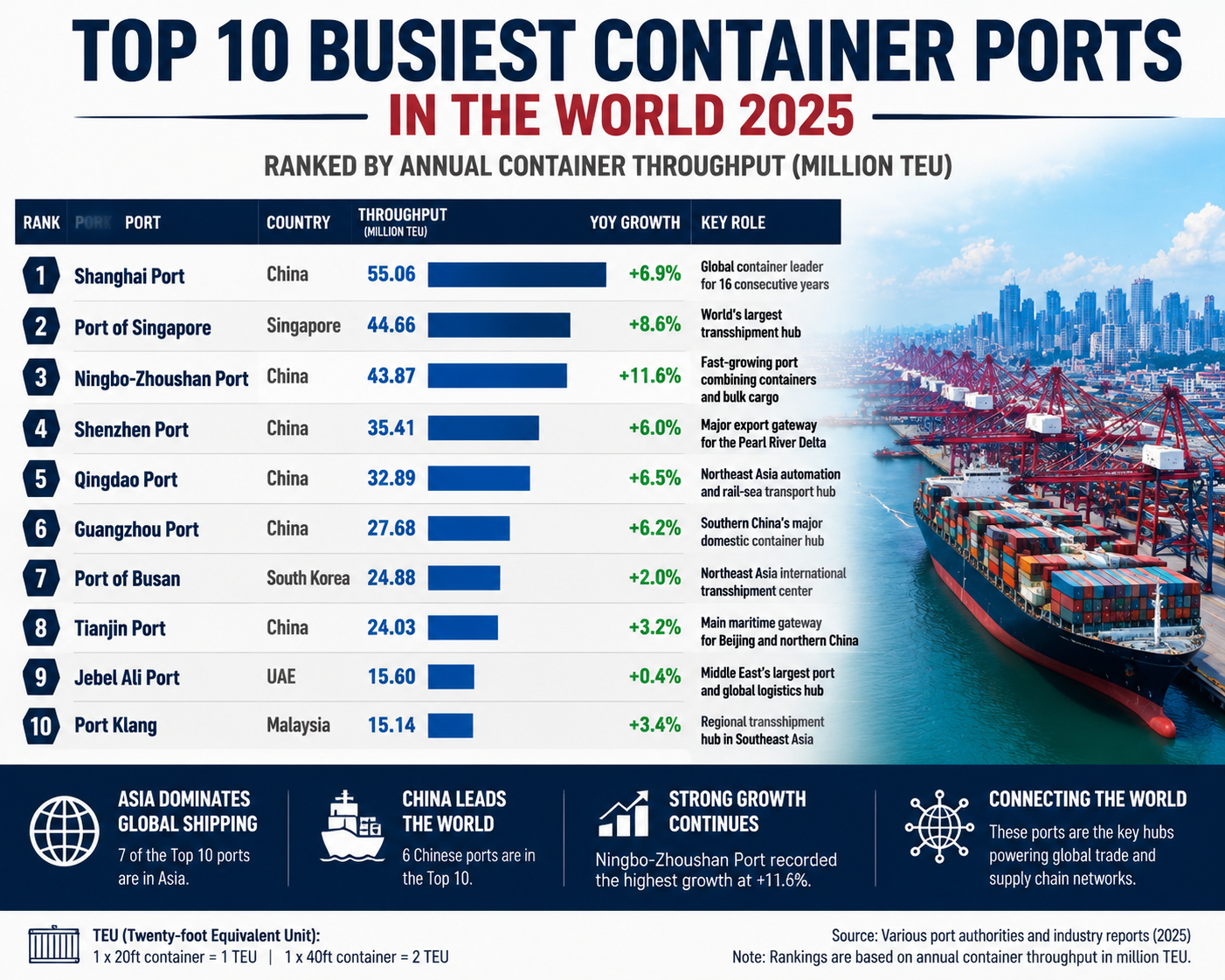
Ranked by annual container throughput measured in TEU (Twenty-foot Equivalent Units), these are the world’s busiest container ports in 2025.
Top 10 Container Ports by Throughput in 2025
| Rank | Port | Country | Throughput (Million TEU) | YoY Growth | Key Role |
|---|---|---|---|---|---|
| 1 | Shanghai Port | China 🇨🇳 | 55.06M | +6.9% | Global container leader for 16 consecutive years |
| 2 | Port of Singapore | Singapore 🇸🇬 | 44.66M | +8.6% | World’s largest transshipment hub |
| 3 | Ningbo-Zhoushan Port | China 🇨🇳 | 43.87M | +11.6% | Fast-growing port combining containers and bulk cargo |
| 4 | Shenzhen Port | China 🇨🇳 | 35.41M | +6.0% | Major export gateway for the Pearl River Delta |
| 5 | Qingdao Port | China 🇨🇳 | 32.89M | +6.5% | Northeast Asia automation and rail-sea transport hub |
| 6 | Guangzhou Port | China 🇨🇳 | 27.68M | +6.2% | Southern China’s major domestic container hub |
| 7 | Port of Busan | South Korea 🇰🇷 | 24.88M | +2.0% | Northeast Asia international transshipment center |
| 8 | Tianjin Port | China 🇨🇳 | 24.03M | +3.2% | Main maritime gateway for Beijing and northern China |
| 9 | Jebel Ali Port | UAE 🇦🇪 | 15.60M | +0.4% | Middle East’s largest port and global logistics hub |
| 10 | Port Klang | Malaysia 🇲🇾 | 15.14M | +3.4% | Regional transshipment hub in Southeast Asia |
1. Shanghai Port — China 🇨🇳
55.06 Million TEU
Shanghai Port remains the world’s busiest container port, maintaining the No.1 position globally for 16 consecutive years.
Located at the mouth of the Yangtze River, Shanghai benefits from:
- The world’s largest manufacturing cluster in the Yangtze River Delta
- Strong export industries
- Advanced automated container terminals
- Extensive international shipping networks
The port is a critical gateway connecting China’s economy with global markets.
2. Port of Singapore — Singapore 🇸🇬
44.66 Million TEU
Singapore remains the world’s most important transshipment hub.
Located along the Strait of Malacca, one of the world’s busiest maritime routes, Singapore connects major trade routes between:
- Asia
- Europe
- The Middle East
- Africa
More than its domestic trade volume, Singapore’s strength comes from its global container transfer network.
3. Ningbo-Zhoushan Port — China 🇨🇳
43.87 Million TEU
Ningbo-Zhoushan Port recorded one of the strongest growth rates among the world’s largest container ports, increasing 11.6% year over year.
Its advantages include:
- Deep-water port facilities
- Strong manufacturing connections
- Combination of container shipping and bulk cargo operations
It plays an increasingly important role in China’s international trade.
4. Shenzhen Port — China 🇨🇳
35.41 Million TEU
Located in Guangdong Province, Shenzhen Port serves one of the world’s largest manufacturing regions.
The port supports exports of:
- Electronics
- Technology products
- Consumer goods
- Electric vehicles
It remains one of China’s most important gateways for global trade.
5. Qingdao Port — China 🇨🇳
32.89 Million TEU
Qingdao Port is a major logistics hub in northern China.
The port is recognized for:
- Automated container terminals
- Efficient sea-rail transportation
- Strong connections with Northeast Asia
It plays an important role in regional supply chains.
6. Guangzhou Port — China 🇨🇳
27.68 Million TEU
Guangzhou Port supports the rapidly growing Greater Bay Area economy.
Its strengths include:
- Large domestic container transportation network
- Manufacturing industry connections
- International shipping routes
It remains one of China’s key southern ports.
7. Port of Busan — South Korea 🇰🇷
24.88 Million TEU
Busan Port is South Korea’s largest container port and one of Northeast Asia’s most important logistics centers.
Its strategic advantages include:
- Location between China and Japan
- Advanced container facilities
- Strong international transshipment operations
8. Tianjin Port — China 🇨🇳
24.03 Million TEU
Tianjin Port is the primary maritime gateway for Beijing and northern China.
The port supports:
- Beijing-Tianjin-Hebei economic region
- Industrial exports
- International supply chains
9. Jebel Ali Port — United Arab Emirates 🇦🇪
15.60 Million TEU
Located in Dubai, Jebel Ali Port is the largest container port in the Middle East.
Its importance comes from:
- Strategic location between Asia and Europe
- Dubai’s logistics infrastructure
- Free trade zone advantages
It serves as a major connection point between Europe, Asia, and Africa.
10. Port Klang — Malaysia 🇲🇾
15.14 Million TEU
Port Klang has become one of Southeast Asia’s most important container hubs.
Its growth is supported by:
- Regional manufacturing expansion
- Increasing ASEAN trade
- Strategic location near major shipping routes
Key Insights
China Dominates Global Container Shipping
China continues to lead global container transportation.
Among the world’s Top 10 busiest container ports:
- 6 ports are located in China
- China accounts for more than half of the total throughput among the Top 10 ports
This reflects China’s position as the world’s largest manufacturing and exporting economy.
Asia Controls Global Maritime Trade
Asian ports dominate the ranking:
- China
- Singapore
- South Korea
- Malaysia
Together, they represent the center of global supply chains.
The World’s Largest Ports Are Becoming More Automated
Modern container ports are investing heavily in:
- Artificial intelligence
- Automated cranes
- Smart logistics systems
- Digital supply chain management
Automation is becoming a key competitive advantage for future maritime trade.
What Does TEU Mean?
TEU (Twenty-foot Equivalent Unit) is the standard measurement used to calculate container shipping volume.
Examples:
- 1 × 20-foot container = 1 TEU
- 1 × 40-foot container = 2 TEU
Frequently Asked Questions
Which is the world’s busiest container port in 2025?
Shanghai Port, China, ranked first with approximately 55.06 million TEU.
Which country has the most Top 10 container ports?
China, with six ports appearing in the global Top 10 ranking.
Why are Asian ports dominant?
Asia’s dominance comes from:
- Manufacturing concentration
- Export-oriented economies
- Regional supply chain networks
- High-volume international trade
About the Author