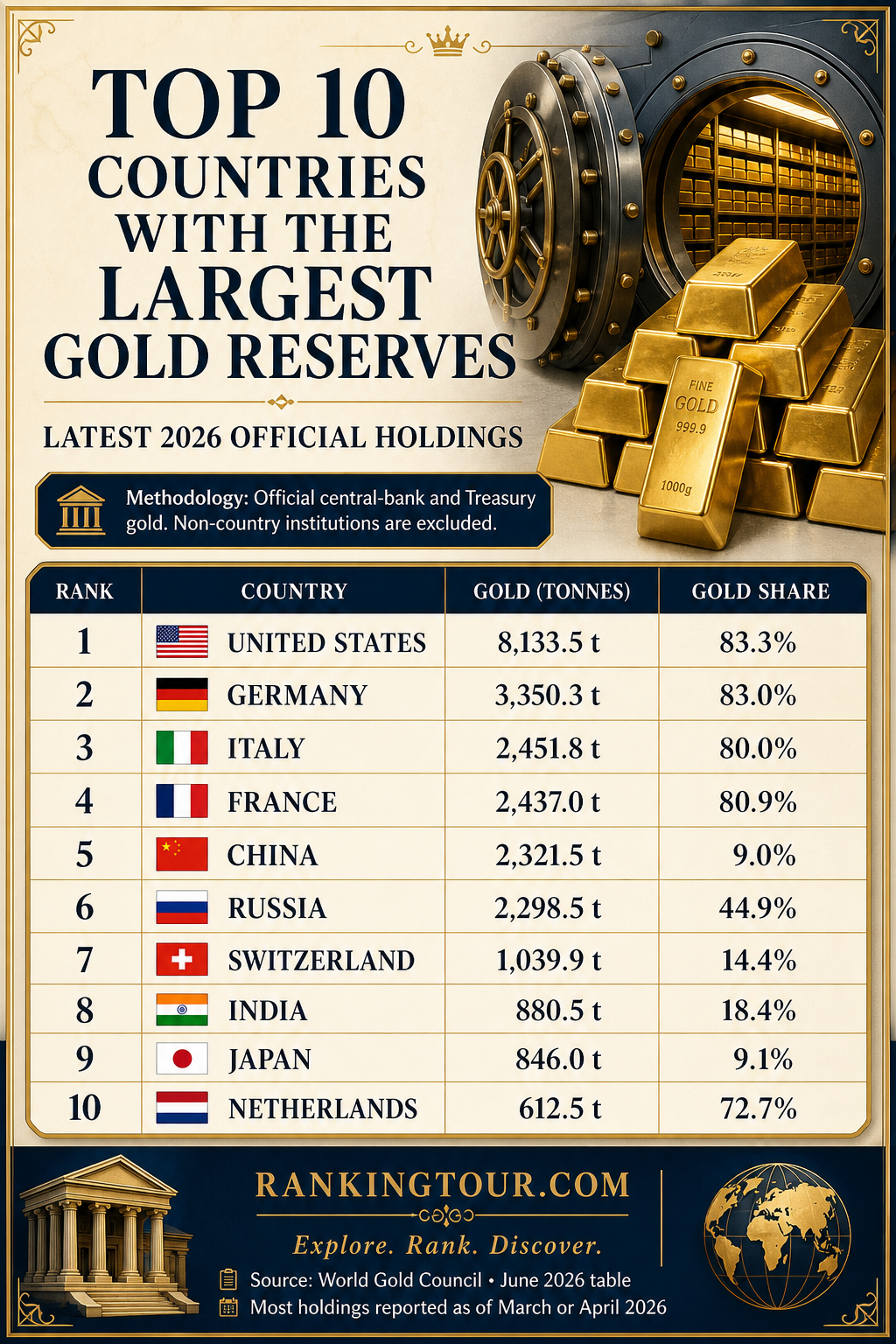
The ten countries with the largest official gold reserves, based on the World Gold Council's June 2026 table.
Updated July 12, 2026. Gold remains one of the world’s most important official reserve assets. Central banks hold it for diversification, liquidity, crisis protection and confidence—but a handful of countries control a remarkably large share of the official total.
This RankingTour list ranks sovereign countries by reported official-sector gold holdings. It uses the World Gold Council’s June 2026 table, which draws primarily on the International Monetary Fund’s International Financial Statistics and other official sources. Most country figures were reported for March or April 2026.
Top 10 Countries With the Largest Gold Reserves in 2026
| Rank | Country | Official gold | Gold share of reserves |
|---|---|---|---|
| 1 | United States | 8,133.5 tonnes | 83.3% |
| 2 | Germany | 3,350.3 tonnes | 83.0% |
| 3 | Italy | 2,451.8 tonnes | 80.0% |
| 4 | France | 2,437.0 tonnes | 80.9% |
| 5 | China | 2,321.5 tonnes | 9.0% |
| 6 | Russia | 2,298.5 tonnes | 44.9% |
| 7 | Switzerland | 1,039.9 tonnes | 14.4% |
| 8 | India | 880.5 tonnes | 18.4% |
| 9 | Japan | 846.0 tonnes | 9.1% |
| 10 | Netherlands | 612.5 tonnes | 72.7% |
Important definition: this is a ranking of monetary gold held by central banks and national treasuries—not underground mineral reserves, annual mine production, privately owned bullion, jewelry or household gold. Non-country institutions such as the International Monetary Fund and European Central Bank are excluded.
1. United States — 8,133.5 Tonnes
The United States holds by far the world’s largest official gold stockpile. Its 8,133.5 tonnes are more than the combined holdings of Germany, Italy and France, the next three countries in the ranking.
Most U.S. gold is held at locations associated with the Treasury, including the Fort Knox bullion depository, West Point and Denver. The Federal Reserve Bank of New York also stores gold, although much of the metal in its vault belongs to foreign governments and international institutions rather than the United States.
Gold represented approximately 83.3% of reported U.S. reserves in the June 2026 table. This high share partly reflects the structure used for the comparison and the large increase in gold’s market value.
2. Germany — 3,350.3 Tonnes
Germany has the world’s second-largest national gold reserve and Europe’s largest. The Bundesbank built much of the stockpile during the decades of strong postwar exports, when foreign currency received through trade was converted into gold under the international monetary system of the period.
Germany stores its gold across Frankfurt, New York and London. A major repatriation program completed ahead of schedule moved hundreds of tonnes back to Frankfurt while maintaining overseas holdings for access to important gold trading centers.
At 83.0% of reserves, Germany’s reported gold share was almost identical to that of the United States.
3. Italy — 2,451.8 Tonnes
Italy ranks third despite having a smaller economy than several countries below it. Its official holdings have remained remarkably stable for decades, making gold a long-term anchor on the balance sheet of the Bank of Italy.
The reserve is held both domestically and in major international financial centers. Italy’s gold is often discussed during periods of fiscal stress, but it remains an official reserve asset rather than an ordinary government spending account.
Gold accounted for approximately 80.0% of Italy’s reported reserves.
4. France — 2,437.0 Tonnes
France sits just behind Italy, with only about 14.8 tonnes separating the two countries. The Banque de France holds much of the country’s gold in its historic underground vault complex in Paris.
Like Germany and Italy, France accumulated a large portion of its reserve during the era when gold played a more direct role in the international monetary system. The country has retained most of that stockpile, giving it one of the highest gold allocations among major economies.
France’s gold share was reported at 80.9% of total reserves.
5. China — 2,321.5 Tonnes
China moved ahead of Russia in the latest ranking, reaching 2,321.5 tonnes. The People’s Bank of China has periodically reported additions as the country diversifies its enormous reserve portfolio.
China offers the clearest example of why tonnage and reserve share tell different stories. It is the fifth-largest official gold holder by weight, yet gold represented only about 9.0% of its reserves because China also holds a vast portfolio of foreign currencies and securities.
Further purchases could therefore have a meaningful effect on global central-bank demand even without making gold the dominant component of China’s reserves.
6. Russia — 2,298.5 Tonnes
Russia ranks sixth with 2,298.5 tonnes. The country was one of the world’s most consistent official buyers during the 2010s, using domestic mine supply to reduce reliance on foreign-currency assets.
Its holdings have changed more noticeably in 2026, allowing China to move into fifth place. Even so, Russia continues to possess one of the world’s largest national gold stockpiles, representing around 44.9% of reported reserves.
7. Switzerland — 1,039.9 Tonnes
Switzerland is the only other country above 1,000 tonnes. Its gold reserve is especially large relative to its population of roughly nine million people.
The country has a long history as a center for bullion trading, refining and private wealth management. Official holdings were reduced in earlier decades, but Switzerland still ranks seventh globally with 1,039.9 tonnes.
Gold represented approximately 14.4% of its reported reserves.
8. India — 880.5 Tonnes
India’s official holdings reached 880.5 tonnes, placing it eighth. The Reserve Bank of India has been a notable buyer in recent years and has also increased the proportion of its gold stored domestically.
India is famous for enormous private and household gold ownership, but that metal is not part of this ranking. Jewelry and privately held bullion may be economically significant, yet official reserves count only the gold held by national monetary authorities.
The official gold share was approximately 18.4%.
9. Japan — 846.0 Tonnes
Japan holds 846.0 tonnes of official gold. The tonnage is substantial, but gold represents only around 9.1% of the country’s reported reserves because Japan has one of the world’s largest foreign-exchange reserve portfolios.
Japan’s position has been relatively stable, with limited changes compared with more active buyers such as China, India and Poland.
10. Netherlands — 612.5 Tonnes
The Netherlands completes the top ten with 612.5 tonnes. De Nederlandsche Bank has described gold as an asset that can support confidence in the financial system, especially during severe crises.
The country stores gold domestically and abroad. With gold representing roughly 72.7% of its reported reserves, the Netherlands has a much higher allocation than several larger economies.
Which Countries Are Just Outside the Top 10?
Poland ranked next with approximately 595.6 tonnes, followed by Türkiye with about 535.4 tonnes in the June 2026 table. Poland’s aggressive purchases have made it one of the most closely watched central-bank buyers. Because the gap with the Netherlands is relatively small, the final position in this ranking could change in a future update.
What the Ranking Reveals
The United States remains in a league of its own, while Western European countries continue to hold exceptionally large legacy stockpiles. China, Russia and India show the growing strategic importance of gold among emerging and non-Western powers.
The reserve-share column is equally revealing. China and Japan rank highly by tonnes but keep far larger portfolios of non-gold reserve assets. By contrast, gold accounts for more than 70% of reported reserves in the United States, Germany, Italy, France and the Netherlands.
According to the World Gold Council’s 2026 central-bank survey, 89% of responding reserve managers expected global official gold holdings to rise over the following 12 months, while a record 45% expected their own institutions to increase holdings. That does not guarantee purchases, but it shows that gold remains central to reserve-management discussions.
Methodology and Data Limitations
The primary source is the World Gold Council’s Gold Reserves by Country dataset and its June 2026 World Official Gold Holdings table. The data are compiled mainly from the IMF’s International Financial Statistics and supplemented by central-bank and other official disclosures.
Official data are normally reported with a lag. The June 2026 table mainly reflects March or April 2026 holdings, while late-reporting countries may have older reference dates. Figures can also change because of purchases, sales, swaps, deposits, statistical revisions or methodology updates.
Reserve-share percentages are influenced by the market value of gold and by changes in other reserve assets. A rising percentage does not necessarily mean that a central bank bought additional tonnes.
Sources
Key references include the World Gold Council’s country reserve data, its Central Bank Gold Reserves Survey 2026, and its Gold Demand Trends: Q1 2026 central-bank analysis. This article is informational and does not constitute investment advice.
Hashtags
#GoldReserves #Gold #CentralBanks #OfficialGold #UnitedStates #Germany #Italy #France #China #Russia #Switzerland #India #Japan #Netherlands #GlobalEconomy #WorldRanking #RankingTour
About the Author