Top 10 longest-reigning current royal heads of state in 2026.
Updated: July 11, 2026
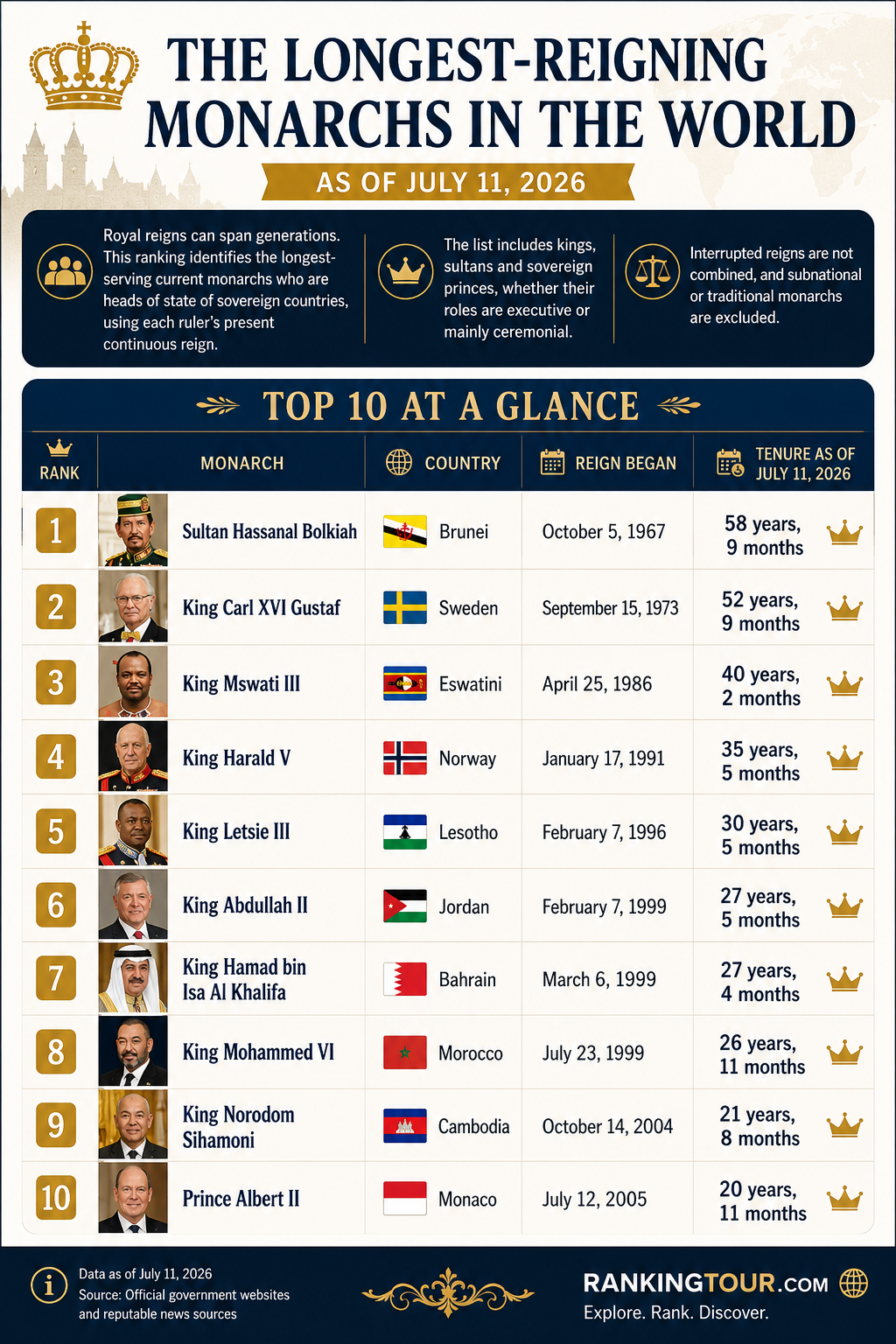
Royal reigns can span generations. This ranking identifies the longest-serving current monarchs who are heads of state of sovereign countries, using each ruler’s present continuous reign.
The list includes kings, sultans and sovereign princes, whether their roles are executive or mainly ceremonial. Interrupted reigns are not combined, and subnational or traditional monarchs are excluded.
Top 10 at a Glance
| Rank | Monarch | Country | Reign Began | Tenure as of July 11, 2026 |
|---|---|---|---|---|
| 1 | Sultan Hassanal Bolkiah | Brunei | October 5, 1967 | 58 years, 9 months |
| 2 | King Carl XVI Gustaf | Sweden | September 15, 1973 | 52 years, 9 months |
| 3 | King Mswati III | Eswatini | April 25, 1986 | 40 years, 2 months |
| 4 | King Harald V | Norway | January 17, 1991 | 35 years, 5 months |
| 5 | King Letsie III | Lesotho | February 7, 1996 | 30 years, 5 months |
| 6 | King Abdullah II | Jordan | February 7, 1999 | 27 years, 5 months |
| 7 | King Hamad bin Isa Al Khalifa | Bahrain | March 6, 1999 | 27 years, 4 months |
| 8 | King Mohammed VI | Morocco | July 23, 1999 | 26 years, 11 months |
| 9 | King Norodom Sihamoni | Cambodia | October 14, 2004 | 21 years, 8 months |
| 10 | Prince Albert II | Monaco | July 12, 2005 | 20 years, 11 months |
10. Prince Albert II — Monaco
Albert II became Monaco’s sovereign prince in July 2005 after the death of his father, Prince Rainier III. As head of state, he has combined Monaco’s traditional royal identity with a prominent international focus on ocean conservation, climate change and sustainable development.
9. King Norodom Sihamoni — Cambodia
Norodom Sihamoni was selected by Cambodia’s Royal Council of the Throne on October 14, 2004, following the abdication of his father, Norodom Sihanouk. Cambodia is an elective monarchy: the crown is not inherited automatically, and the king is chosen for life from eligible royal descendants. His constitutional role is largely ceremonial and symbolic.
8. King Mohammed VI — Morocco
Mohammed VI succeeded his father, Hassan II, on July 23, 1999. His reign has included major infrastructure investment, economic modernization and constitutional reform, while the monarchy continues to occupy a central position in Morocco’s political and religious life.
7. King Hamad bin Isa Al Khalifa — Bahrain
Hamad bin Isa Al Khalifa became Bahrain’s ruler on March 6, 1999, initially as emir. He adopted the title of king in 2002 when Bahrain was declared a kingdom. Because he remained the country’s continuous hereditary head of state throughout the title change, this ranking begins his tenure in 1999.
6. King Abdullah II — Jordan
Abdullah II assumed his constitutional powers on February 7, 1999, after the death of King Hussein. His long reign has unfolded amid repeated regional crises, and the Hashemite monarchy remains a central institution in Jordan’s government, diplomacy and national identity.
5. King Letsie III — Lesotho
Letsie III was restored to the throne on February 7, 1996, after the death of his father, Moshoeshoe II. He had previously reigned from 1990 to 1995, but that first period ended when he abdicated. To keep the ranking consistent, only his present uninterrupted reign from 1996 is counted.
4. King Harald V — Norway
Harald V became king immediately upon the death of his father, Olav V, on January 17, 1991. Norway’s constitution assigns the monarch formal duties, but in practice the king’s work is primarily representative and ceremonial. Harald has served as a durable symbol of national continuity for more than 35 years.
3. King Mswati III — Eswatini
Mswati III was crowned on April 25, 1986, shortly after his 18th birthday. Eswatini is Africa’s last absolute monarchy, and the king exercises far greater political authority than most modern monarchs, including influence over senior appointments and the country’s legislative system.
2. King Carl XVI Gustaf — Sweden
Carl XVI Gustaf acceded to the Swedish throne on September 15, 1973, following the death of his grandfather, Gustaf VI Adolf. Sweden’s 1974 Instrument of Government removed the monarch’s remaining political powers, leaving the king with ceremonial and representative duties. He marked 50 years on the throne in 2023.
1. Sultan Hassanal Bolkiah — Brunei
Hassanal Bolkiah ascended the throne on October 5, 1967, after his father abdicated. He is the world’s longest-reigning current monarch and also serves as Brunei’s head of government. His reign predates Brunei’s full independence in 1984 and has now lasted nearly 59 years.
How This Ranking Was Calculated
- Current rulers only: each monarch had to be serving on July 11, 2026.
- Sovereign-state heads of state: subnational, traditional and non-territorial monarchs are excluded.
- Continuous current reign: earlier interrupted reigns are not added.
- Accession rather than coronation: the legal start of the reign is used when it differs from the coronation date.
- Rounded tenure: lengths are shown to the nearest completed month.
Notable Changes in 2025–2026
Grand Duke Henri of Luxembourg would previously have appeared near the bottom of this list, but he abdicated in favor of his son, Guillaume, on October 3, 2025. That change moved Prince Albert II of Monaco into the 2026 top 10. Denmark’s Queen Margrethe II is also absent because she abdicated in January 2024.
Sources
- Brunei Sultanate: accession of Sultan Hassanal Bolkiah
- Royal Court of Sweden
- South African Government: Mswati III’s 40th anniversary
- Royal Court of Norway: 1991 accession
- Government of Lesotho: Office of the King
- Royal Embassy of Cambodia: Monarchy
- Luxembourg monarchy: 2025 abdication timeline
Tenure lengths are calculated as of July 11, 2026. Dates refer to the beginning of each ruler’s current continuous service as monarch and head of state.
About the Author