Top Enterprise Storage Vendors by Revenue Market Share
The enterprise storage market is entering a new growth cycle driven by artificial intelligence, cloud infrastructure expansion, and rapidly increasing data volumes.
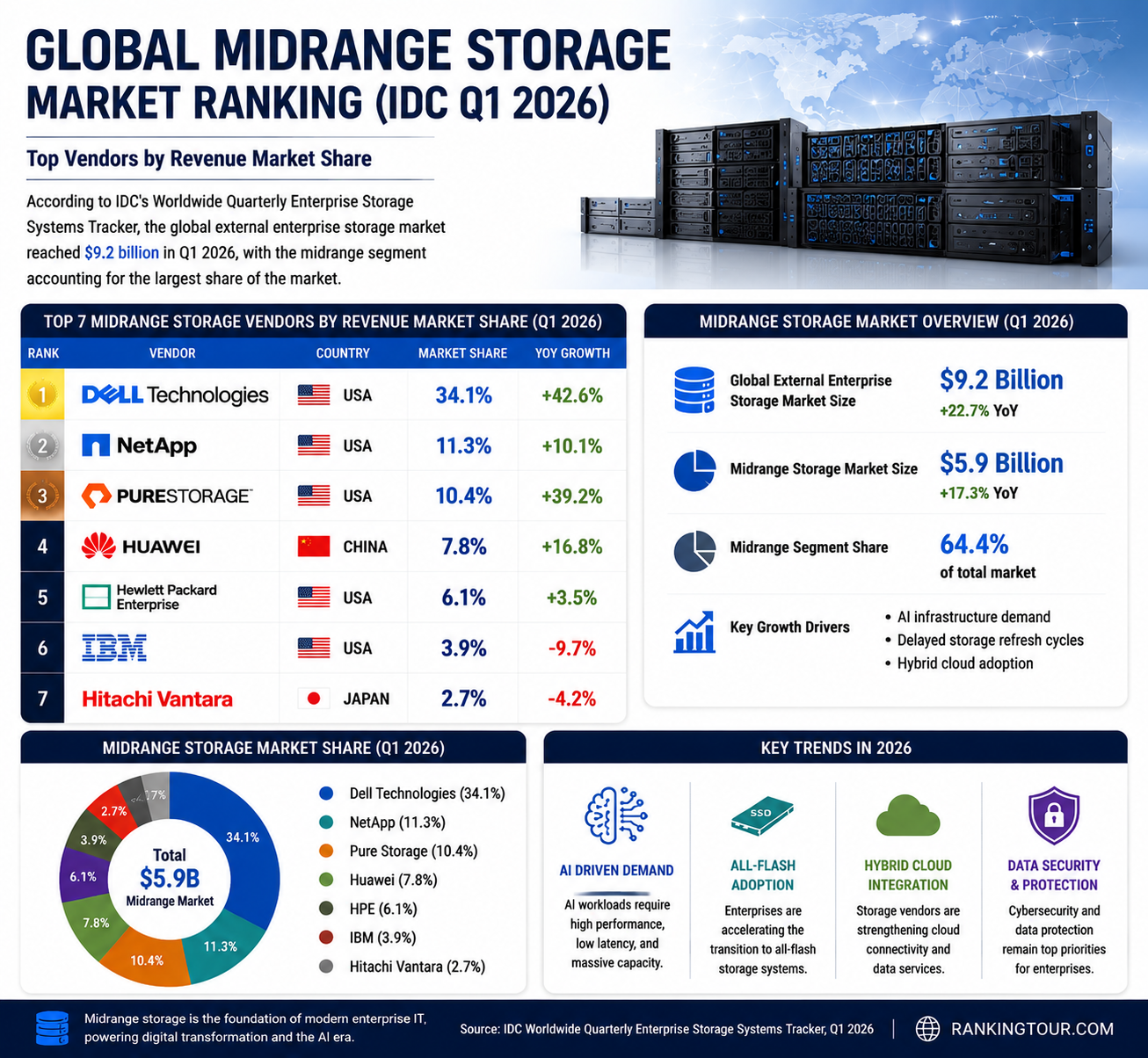
According to IDC’s Worldwide Quarterly Enterprise Storage Systems Tracker, the global external enterprise storage market reached approximately $9.2 billion in vendor revenue in Q1 2026, representing strong year-over-year growth. AI infrastructure demand and enterprise storage refresh cycles were major contributors to market expansion.
Within the enterprise storage industry, midrange storage systems remain the largest and most important segment, serving:
- Small and medium enterprises
- Enterprise departments
- Hybrid cloud environments
- AI data workloads
- Business-critical applications
What Is Midrange Storage?
IDC defines midrange external enterprise storage as storage systems designed for enterprise environments, generally positioned between entry-level systems and high-end mission-critical platforms.
Typical characteristics:
- Enterprise-grade reliability
- All-flash and hybrid architectures
- NVMe support
- Data management software
- Cloud integration
Common use cases:
- Databases
- Virtualization
- AI workloads
- Analytics
- Business applications
Top Midrange Storage Vendors by Global Revenue Market Share
IDC Q1 2026
| Rank | Vendor | Country | Market Share | Main Products |
|---|---|---|---|---|
| 🥇 1 | Dell Technologies | 🇺🇸 USA | ~34.1% | PowerStore, Unity XT |
| 🥈 2 | NetApp | 🇺🇸 USA | ~11.3% | AFF, FAS |
| 🥉 3 | Pure Storage | 🇺🇸 USA | ~10.4% | FlashArray |
| 4 | Huawei | 🇨🇳 China | ~7.8% | OceanStor 5000/6000 |
| 5 | HPE | 🇺🇸 USA | ~6.1% | Alletra, MSA |
| 6 | IBM | 🇺🇸 USA | ~3.9% | FlashSystem |
| 7 | Hitachi Vantara | 🇯🇵 Japan | ~2.7% | VSP Series |
1. Dell Technologies 🇺🇸
The Global Midrange Storage Leader
Dell Technologies remains the dominant player in the global midrange storage market.
Main products:
- PowerStore
- Unity XT
Key strengths:
✅ Enterprise customer base
✅ Strong all-flash storage portfolio
✅ VMware ecosystem integration
✅ AI infrastructure solutions
Dell’s storage business benefited from increased enterprise investment in AI-ready infrastructure and modernization projects.
2. NetApp 🇺🇸
Hybrid Cloud Storage Specialist
NetApp continues to maintain a strong position in enterprise storage.
Main products:
- AFF (All Flash FAS)
- FAS Hybrid Storage
Strengths:
- Hybrid cloud management
- Data services
- Multi-cloud environments
NetApp is particularly strong among enterprises requiring flexible data management across on-premise and cloud environments.
3. Pure Storage 🇺🇸
The Fast-Growing All-Flash Storage Company
Pure Storage has become one of the fastest-growing players in enterprise storage.
Main product:
- FlashArray
Competitive advantages:
✅ All-flash architecture
✅ Subscription-based storage model
✅ Simple management
✅ High-performance workloads
Pure Storage has gained momentum from enterprises upgrading traditional storage infrastructure for AI and modern applications.
4. Huawei 🇨🇳
China’s Leading Enterprise Storage Vendor
Huawei OceanStor has become a major competitor, especially in:
- China
- Asia-Pacific
- Government projects
- Telecommunications
Main products:
- OceanStor 5000 series
- OceanStor 6000 series
Strengths:
- Large domestic market
- Strong enterprise relationships
- Integrated ICT ecosystem
5. HPE 🇺🇸
Enterprise Infrastructure Provider
HPE remains an important player in enterprise storage.
Main products:
- Alletra
- MSA
Strengths:
- Server + storage integration
- Enterprise customers
- Hybrid cloud solutions
HPE benefits from bundled infrastructure deals combining:
- Servers
- Networking
- Storage
6. IBM 🇺🇸
Mission-Critical Storage Specialist
IBM continues to serve large enterprises requiring high reliability.
Main product:
- IBM FlashSystem
Key markets:
- Financial services
- Government
- Large enterprises
IBM’s storage business focuses on:
- Data protection
- Hybrid cloud
- Mission-critical workloads
7. Hitachi Vantara 🇯🇵
Enterprise Storage Specialist in Japan
Hitachi Vantara maintains a strong position in specific markets.
Main products:
- Virtual Storage Platform (VSP)
Strengths:
- Financial institutions
- Large Japanese enterprises
- Mission-critical systems
Key Trends Shaping the Midrange Storage Market in 2026
1. AI Is Driving Storage Demand
Artificial intelligence requires:
- Massive data capacity
- Faster storage performance
- Lower latency
- High availability
AI workloads are becoming one of the biggest growth drivers for enterprise storage.
2. All-Flash Storage Adoption Accelerates
Companies are replacing traditional HDD-based systems with:
- NVMe storage
- SSD arrays
- AI-optimized platforms
Benefits:
- Faster performance
- Lower energy consumption
- Better scalability
3. Storage Becomes an AI Infrastructure Foundation
The future enterprise stack:
AI Models
    ↓
GPU Computing
    ↓
High-Speed Storage
    ↓
Enterprise Data
Storage is no longer just a backup system — it has become a critical component of AI infrastructure.
Global Midrange Storage Market Outlook
The next generation of enterprise storage will be defined by:
🤖 AI-ready infrastructure
☁️ Hybrid cloud integration
⚡ All-flash adoption
🔐 Data security
📊 Real-time analytics
Companies that can provide faster, smarter, and more efficient storage platforms will lead the next phase of enterprise computing.
Conclusion
The global midrange storage market is becoming increasingly important as enterprises prepare for the AI era.
Dell Technologies continues to dominate the market, while NetApp, Pure Storage, Huawei, and HPE compete for leadership in different regions and industries.
As data volumes continue to grow, enterprise storage will remain a critical foundation for:
- Artificial intelligence
- Cloud computing
- Digital transformation
- Future enterprise infrastructure
About the Author