Coffee is one of the world’s most widely traded agricultural commodities. Every year, billions of kilograms of green coffee beans are exported across continents to feed roasters, cafes and instant coffee manufacturers. Output varies significantly by country, split between high-quality Arabica and higher-yield Robusta varieties.
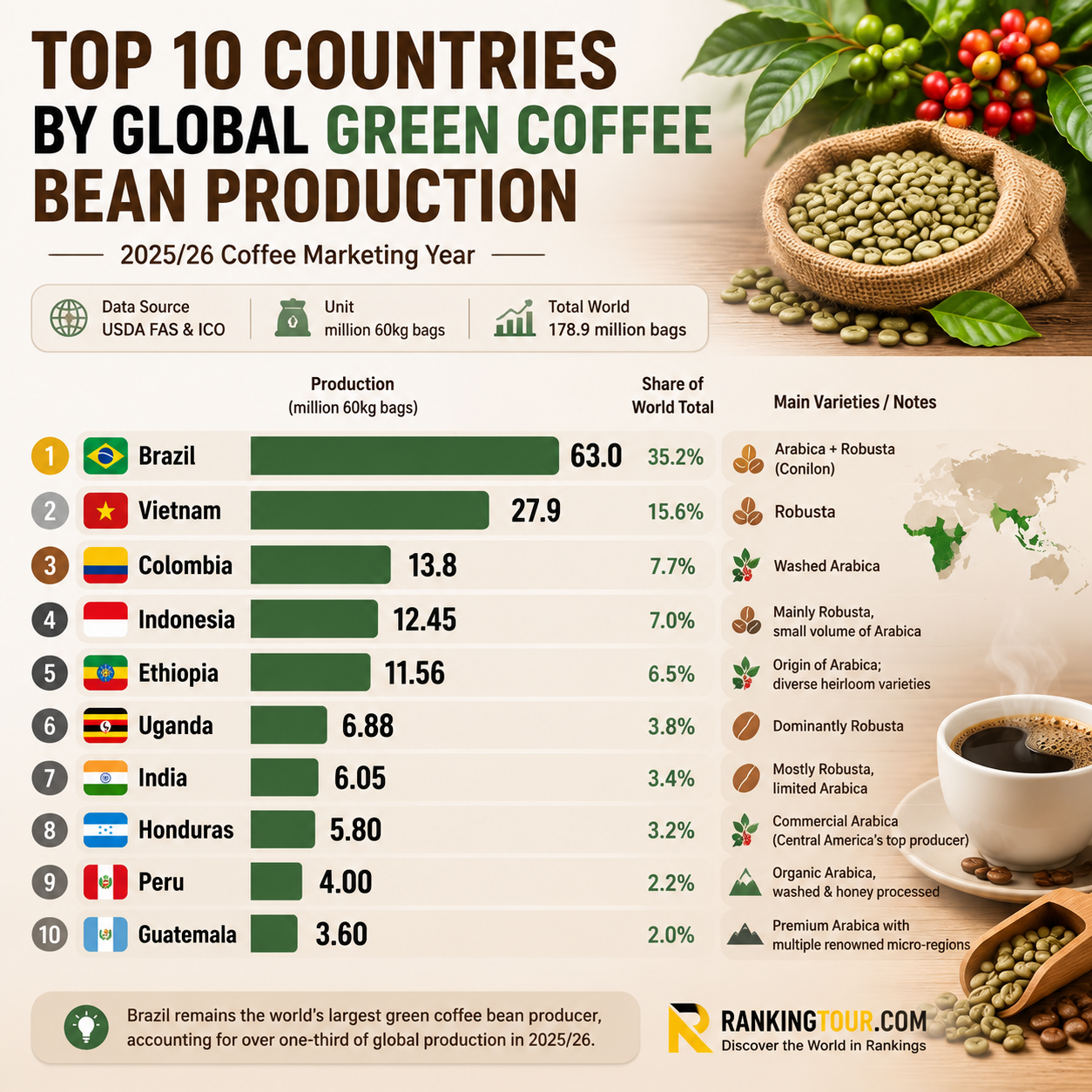
Below is the official production ranking based on combined forecasts from the USDA FAS and International Coffee Organization (ICO). All volumes are measured in million 60kg bags, the standard unit within the global coffee trade. The global total production for the 2025/26 season reaches approximately 178.8 million bags.
| Rank | Country | Production (Million 60kg Bags) | Global Share | Primary Coffee Varieties |
|---|---|---|---|---|
| 1 | Brazil | 63.0 | 35.2% | Arabica + Robusta (Conilon) |
| 2 | Vietnam | 27.9 | 15.6% | Robusta |
| 3 | Colombia | 13.8 | 7.7% | Washed Arabica |
| 4 | Indonesia | 12.45 | 7.0% | Robusta, small Arabica volume |
| 5 | Ethiopia | 11.56 | 6.5% | Heirloom Arabica |
| 6 | Uganda | 6.88 | 3.8% | Robusta |
| 7 | India | 6.05 | 3.4% | Robusta, limited Arabica |
| 8 | Honduras | 5.80 | 3.2% | Commercial Arabica |
| 9 | Peru | 4.00 | 2.2% | Organic Arabica |
| 10 | Guatemala | 3.60 | 2.0% | Premium Arabica |
Ranking Overview
- Brazil remains the undisputed leader, supplying more than one-third of all coffee globally. It produces both Arabica for specialty and commercial markets and domestic Conilon Robusta.
- Vietnam dominates global Robusta supply, largely supporting the massive instant coffee industry worldwide.
- Colombia is the largest pure Arabica exporter, famous for consistent washed coffee flavour profiles.
- Indonesia delivers iconic regional origins including Mandheling, with production tilted toward Robusta.
- Ethiopia, the birthplace of Arabica, provides sought-after heirloom varieties for the specialty coffee sector.
- Uganda and India focus primarily on Robusta, serving blending and instant demand.
- Central American producers Honduras, Peru and Guatemala specialise in Arabica, ranging from affordable commercial lots to high-value single-origin beans.
Important Notes
Coffee trees follow a biennial bearing cycle, meaning harvest volumes naturally alternate between higher and lower yields each season. Figures are forecasts for the 2025/26 coffee marketing year and may see minor revisions. Production data sourced from USDA FAS and ICO.
About the Author