Population size remains one of the most important indicators of a country’s global influence, economic potential, labor force, and future development trends.
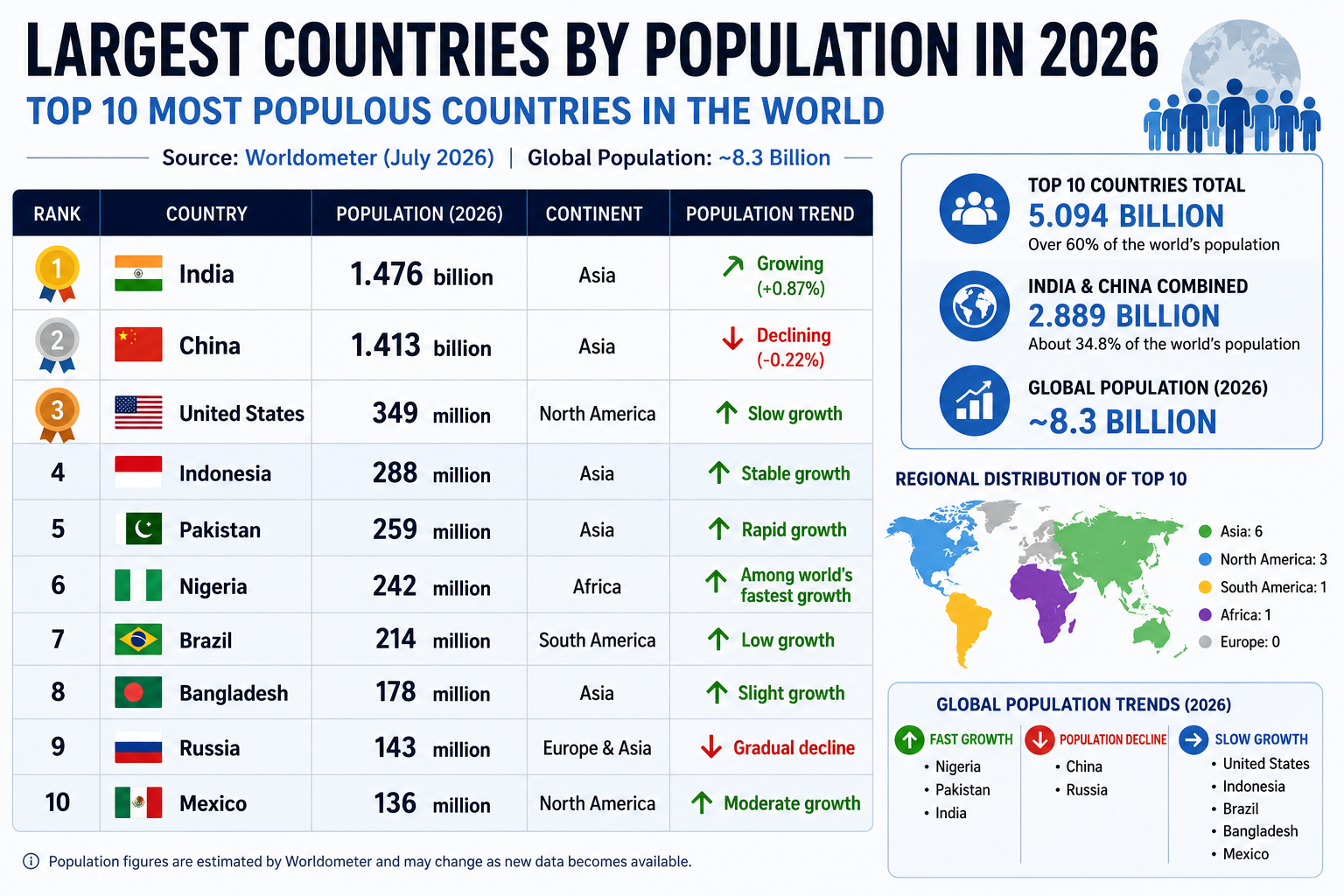
According to the latest 2026 Worldometer population estimates, the global population has reached approximately 8.3 billion people, with the world’s top 10 most populous countries accounting for more than 5 billion people, representing over 60% of the global population.
The global population landscape has experienced a historic shift in recent years. India surpassed China as the world’s most populous country in 2023, and it continues to maintain the No.1 position in 2026.
Top 10 Most Populous Countries in the World (2026)
| Rank | Country | Population (2026) | Continent | Population Trend |
|---|---|---|---|---|
| 1 | India | 1.476 billion | Asia | Growing (+0.87%) |
| 2 | China | 1.413 billion | Asia | Declining (-0.22%) |
| 3 | United States | 349 million | North America | Slow growth |
| 4 | Indonesia | 288 million | Asia | Stable growth |
| 5 | Pakistan | 259 million | Asia | Rapid growth |
| 6 | Nigeria | 242 million | Africa | Among world’s fastest growth rates |
| 7 | Brazil | 214 million | South America | Low growth |
| 8 | Bangladesh | 178 million | Asia | Slight growth |
| 9 | Russia | 143 million | Europe & Asia | Gradual decline |
| 10 | Mexico | 136 million | North America | Moderate growth |
1. India 🇮🇳 — 1.476 Billion People
India remains the world’s most populous country in 2026 after overtaking China in 2023.
With a population exceeding 1.4 billion, India has a large young workforce and continues to experience population growth.
Key factors:
- Large working-age population
- Expanding consumer market
- Rapid technology and manufacturing growth
- Growing global economic influence
India’s demographic advantage is expected to remain a major factor in its long-term economic development.
2. China 🇨🇳 — 1.413 Billion People
China ranks second globally with more than 1.4 billion people.
Although China remains one of the world’s largest consumer markets and manufacturing centers, its population has entered a declining phase.
Major demographic challenges:
- Lower birth rates
- Aging population
- Shrinking workforce
China’s population decreased by approximately 0.22% in 2026, marking a continuing demographic transition.
3. United States 🇺🇸 — 349 Million People
The United States ranks third worldwide with around 349 million people.
Unlike many developed economies, the U.S. continues to experience population growth due to:
- Immigration
- Higher birth rates compared with many developed countries
- Economic opportunities attracting global workers
The U.S. remains the largest population center in North America.
4. Indonesia 🇮🇩 — 288 Million People
Indonesia is the fourth most populous country in the world and the largest country in Southeast Asia by population.
With nearly 290 million people, Indonesia benefits from:
- Large domestic market
- Young workforce
- Growing digital economy
Its population continues to increase steadily.
5. Pakistan 🇵🇰 — 259 Million People
Pakistan ranks fifth globally and is one of the fastest-growing large populations.
Key demographic characteristics:
- Young population structure
- High population growth rate
- Expanding labor force
Pakistan’s population is expected to continue rising significantly in the coming decades.
6. Nigeria 🇳🇬 — 242 Million People
Nigeria is Africa’s most populous country and ranks sixth globally.
It is also one of the world’s fastest-growing major populations.
Key factors:
- High birth rate
- Young population
- Rapid urbanization
Nigeria is expected to become one of the world’s largest population centers in the future.
7. Brazil 🇧🇷 — 214 Million People
Brazil remains the largest country in South America by population.
Although population growth has slowed, Brazil continues to maintain:
- The largest consumer market in Latin America
- A major workforce
- Regional economic influence
Brazil’s demographic growth is now relatively low compared with previous decades.
8. Bangladesh 🇧🇩 — 178 Million People
Bangladesh ranks eighth worldwide despite having one of the highest population densities globally.
The country has experienced major economic development while maintaining a large workforce.
Population characteristics:
- Dense urban population
- Growing manufacturing sector
- Gradual population growth
9. Russia 🇷🇺 — 143 Million People
Russia ranks ninth globally by population.
As the largest country by land area, Russia has a relatively low population density.
Current demographic challenges include:
- Population decline
- Aging society
- Lower birth rates
Russia’s population has been gradually decreasing in recent years.
10. Mexico 🇲🇽 — 136 Million People
Mexico completes the global top 10 population ranking.
With more than 130 million people, Mexico benefits from:
- Young workforce
- Strong manufacturing sector
- Close economic ties with the United States
Population growth continues at a moderate pace.
Regional Distribution of the World’s Top 10 Population Countries
The geographic distribution shows a strong concentration in Asia.
Asia Dominates Global Population
Among the top 10:
Asia: 6 countries
- India
- China
- Indonesia
- Pakistan
- Bangladesh
- Russia
Together, these countries represent a significant portion of global population.
Americas: 3 countries
- United States
- Brazil
- Mexico
Africa: 1 country
- Nigeria
Europe
No European country appears separately in the top 10.
India and China: The World’s Largest Population Centers
India and China remain the two largest population countries.
Combined population:
India + China = approximately 2.89 billion people
This represents nearly:
34.8% of the world’s total population
Together, these two countries continue to shape global:
- Labor markets
- Consumer demand
- Manufacturing
- Technology development
Global Population Growth Trends in 2026
The world’s population growth is becoming increasingly uneven.
Fast Population Growth
Countries with strong population expansion:
- Nigeria
- Pakistan
- India
These nations benefit from younger populations and expanding labor forces.
Population Decline
Countries experiencing demographic contraction:
- China
- Russia
Challenges include:
- Aging populations
- Lower fertility rates
- Workforce reduction
Slow Growth Countries
Countries with moderate increases:
- United States
- Indonesia
- Brazil
- Bangladesh
- Mexico
Conclusion
The global population ranking in 2026 highlights a major demographic transformation.
India has become the world’s largest population country, while China faces a new era of population decline. Meanwhile, countries such as Nigeria and Pakistan are emerging as future population centers due to rapid growth.
Although population size alone does not determine economic power, demographic trends will continue to influence global markets, workforce availability, and geopolitical influence in the decades ahead.
Data Source
Population estimates are based on the latest Worldometer 2026 population data.
About the Author